Authoritarian States (20th century)
Download PDFHow to Use This Guide
- Paper 2 World History Topic 10 covers the emergence, consolidation, and policies of authoritarian states in the 20th century
- Paper 2 is a 90-minute exam in which you write two essays, each worth 15 marks — one from Topic 10 and one from another World History topic (or both from Topic 10)
- This topic is identical for SL and HL students — both sit the same Paper 2 questions. HL students also sit Paper 3 (regional option), but that is separate
- The single most important rule: questions often ask you to refer to two authoritarian states from different regions. Hitler (Europe) and Stalin (Europe) cannot be paired together — you must cross regions. Pair one European leader (Hitler or Mussolini) with one non-European leader (Stalin is USSR/Eurasia and is acceptable as a contrast — or use Mao, Castro, etc.)
- Exam Alerts flag the traps that cost marks in essays
- IB Tips highlight what examiners reward in extended responses
- Worked Examples provide model essay outlines for common question types
Aligned to IB History SL/HL World History Topic 10 — current syllabus
Quick Reference:
- Exam Focus: Paper 2 World History Topic 10 (90 minutes, 2 essays, 15 marks each)
- Key Case Studies: Hitler (Germany), Stalin (USSR), Mussolini (Italy), Mao (China), Castro (Cuba)
- Timeline: 1917–1950s (Lenin’s death 1924, Hitler appointed 1933, Stalin’s purges 1936–38)
- Common Questions: Rise to power, consolidation methods, economic/social policies, use of propaganda
- Critical Rule: Must compare leaders from different regions (Hitler + Stalin acceptable; Hitler + Mussolini not)
What’s covered in this guide:
- Theme 1: Emergence of Authoritarian States — Conditions and methods of seizing power
- Theme 2: Consolidation and Maintenance of Power — Legal paths to dictatorship, terror, propaganda
- Theme 3: Aims and Results of Policies — Economic, social, and foreign policies
Videos on this page: Overview — Authoritarian States · Emergence and Rise to Power · Consolidation of Power · Policies and Control · Rise of Hitler — Weimar to Nazi Germany
Watch: Overview — What Are Authoritarian States?
Section 1: Theme 1 — Emergence of Authoritarian States
1.1 What Is an Authoritarian State?
An authoritarian state is a political system in which one person or group holds power without meaningful democratic accountability, suppresses political opposition, and typically controls the economy, society, and culture to varying degrees. The term covers a spectrum from authoritarian (some limits on power, some independent institutions) to totalitarian (attempting complete control of every aspect of public and private life).
Key distinctions for the exam:
| Term | Definition | Example |
|---|---|---|
| Authoritarian | Concentrated power, limited pluralism, weak opposition | Mussolini’s Italy (especially 1922–1935) |
| Totalitarian | Complete control attempted over state, society, economy, culture, and private belief | Stalin’s USSR, Hitler’s Germany |
| One-party state | Single legal political party; other parties banned | All three case studies by mid-1930s |
| Fascist | Extreme nationalism, anti-Marxism, anti-liberalism, glorification of violence and the state | Germany, Italy |
Exam Alert: Examiners do not require you to prove that a state was “truly totalitarian” — this is an academic debate. Your task is to analyse the methods used to establish and maintain power and assess how effectively they worked. Avoid spending paragraphs debating definitions; spend them on evidence.
1.2 Conditions That Enable Authoritarian Rule
Across all three case studies, similar conditions created the opening for authoritarian leaders. Understanding these conditions is the foundation of any “emergence” essay.
The conditions that produce authoritarian states are not accidental — they form a pattern. Economic collapse destroys faith in existing governments, war creates grievances that radical nationalists can exploit, weak political systems cannot respond effectively, and social divisions give demagogues identifiable enemies to blame.
Economic Crisis
- Germany: The Great Depression (1929) destroyed the Weimar Republic’s credibility. Unemployment rose from 1.3 million (1929) to 6.1 million by January 1933 (official figure — real unemployment was higher). Hyperinflation had already devastated savings in 1923; now deflation crushed employment. Nazi electoral support rose in direct proportion to unemployment.
- Italy: Post-war economic dislocation, 1919–1921: industrial strikes (the “Two Red Years” — Biennio Rosso), factory occupations, and rural unrest. Middle-class and landowner fear of socialist revolution made Mussolini’s Black Shirts seem like protectors. Italy had also accumulated enormous war debts and felt economically marginalised by the post-war peace settlement.
- USSR: The Russian economy had been devastated by World War I, the 1917 Revolution, and the Civil War (1918–1921). Agricultural production collapsed. Lenin’s New Economic Policy (NEP, 1921) brought partial recovery but left the USSR a predominantly peasant economy dependent on grain procurement. Stalin exploited the NEP’s inequalities and the Party’s fear of capitalist encirclement to justify radical economic transformation.
Social Division
- Germany: Class tensions between industrial workers (supporting SPD/KPD), the middle class (Mittelstand — artisans, shopkeepers, civil servants who had been ruined by inflation and Depression), the landed aristocracy (Junkers), and the industrialists. The Nazi Party built a cross-class coalition by offering something to each group: anti-communism to elites, nationalism to the middle class, jobs to workers.
- Italy: Sharp divisions between the industrial North (socialist-leaning), the rural South, the Catholic Church, the monarchy, the military, and liberal politicians. Mussolini played these groups off against each other, forming tactical alliances and betraying them when convenient.
- USSR: The Bolshevik Revolution had shattered the old social order but created new tensions: between the Party elite (Nomenklatura) and ordinary workers, between the urban proletariat and the peasantry, between ethnic Russians and the Soviet republics. Stalin exploited class language — “kulaks” (wealthy peasants), “wreckers,” “enemies of the people” — to mobilise one group against another.
Impact of World War I
World War I’s aftermath is perhaps the single most important context for all three case studies. The war killed 10 million soldiers, generated catastrophic debt, and produced political settlements that left multiple countries feeling humiliated, betrayed, or threatened.
- Germany: Defeat, the “stab-in-the-back” myth (the lie that Germany had been betrayed internally, not defeated militarily), and the Treaty of Versailles (1919) — loss of 13% of territory, 10% of population, all colonies, payment of massive reparations, and the humiliating “war guilt” clause (Article 231). These combined into a powerful resentment that Hitler could channel.
- Italy: The “mutilated victory” (vittoria mutilata) — Italy had fought on the Allied side from 1915 and lost 600,000 men, but received far fewer territories at Paris than promised. The coastal city of Fiume (promised by the Allies to Yugoslavia) became a nationalist flashpoint. D’Annunzio’s occupation of Fiume in 1919 previewed the theatrical politics of fascism.
- USSR: Russia had suffered the worst casualties of any WWI combatant (1.7 million military dead, millions more from disease and starvation), followed immediately by revolution and a brutal civil war. The Bolsheviks ended WWI by signing the humiliating Treaty of Brest-Litovsk (March 1918), ceding vast territories to Germany. This history created a regime deeply fixated on national security and military-industrial modernisation.
Weakness of Democratic/Political Systems
- Germany: The Weimar Republic (1919–1933) had structural flaws: proportional representation that produced endless coalition governments, Article 48 (emergency decree powers that bypassed parliament), a president with quasi-monarchical powers (Hindenburg), and a constitution written in defeat. No single party ever won a majority; governments averaged less than eight months.
- Italy: Liberal Italy’s parliamentary system was characterised by trasformismo — coalition-building through bribery, patronage, and shifting alliances rather than principled governance. The electoral system produced unstable governments; by 1922 there had been five prime ministers in three years. Parliament had no answer to the fascist squads operating openly in the countryside.
- Russia: The Provisional Government (February–October 1917) was fatally weakened by its decision to continue the war. The Bolsheviks’ one-party system, established after violently dissolving the Constituent Assembly (January 1918), left no legitimate mechanism for removing Stalin’s faction from power within the Party.
Conditions for Authoritarian Emergence — ESWP:
- Economic crisis (Depression, post-war dislocation, hyperinflation)
- Social division (class tension, national humiliation, fear of communism/capitalism)
- War impact (defeat, mutilated victory, stab-in-the-back myths)
- Political system weakness (unstable coalitions, constitutional flaws, no effective opposition)
1.3 Methods Used to Seize Power
Adolf Hitler and the Nazi Rise to Power
Hitler combined legal tactics with the threat of violence, propaganda genius, and the exploitation of political miscalculation by the German elite.
The Beer Hall Putsch (November 1923): Hitler’s first attempt at power was a direct coup — 3,000 SA men tried to seize the Munich government and march on Berlin, imitating Mussolini’s March on Rome. It failed completely: police opened fire, 16 Nazis were killed, Hitler was arrested. At his trial, Hitler turned the dock into a propaganda platform, gaining national attention.
The “Legal Path” after 1924: From prison, Hitler decided to seize power through elections and legal manoeuvre. Key tactical decisions:
- Rebuild the NSDAP as a national party, not a Bavarian fringe group
- Use the SA (Sturmabteilung/Brownshirts) to intimidate opponents while maintaining plausible legality
- Exploit the Depression from 1929: Nazi vote share soared from 2.6% (1928) to 18.3% (September 1930) to 37.4% (July 1932)
- Appeal to multiple social groups simultaneously: anti-communism for elites and middle class, nationalism for veterans, economic promises for the unemployed
The Role of the Elites: Hitler did not seize power alone — he was invited into office. On 30 January 1933, President Hindenburg appointed Hitler as Chancellor, believing he could be controlled. The conservative elite (von Papen, Hugenberg) thought they could “box Hitler in” with only two other Nazis in a cabinet of twelve. They were catastrophically wrong.
Propaganda: Joseph Goebbels ran Nazi electoral campaigns from 1929 onwards with unprecedented modern techniques: mass rallies (Nuremberg), aviation tours (“Hitler Over Germany”), film, radio, and poster art. The Nazi message was deliberately vague on specifics but emotionally powerful: national renewal, an end to humiliation, an enemy to blame (Jews, Marxists, Weimar politicians).
Exam Alert: Hitler was NOT elected as Chancellor — he was appointed by Hindenburg. He also never won an outright majority: the Nazis’ best result in a free election was 37.4% in July 1932. Many students write that “Hitler was democratically elected” — this oversimplifies. He used elections to demonstrate mass support, which pressured Hindenburg into appointing him, but appointment by a president is not election to office.
Key numbers to remember:
- 2.6% (1928) — NSDAP vote before the Great Depression; a fringe party
- 37.3% (Jul 1932) — Peak free-election result; largest Reichstag party, but never a majority
- 33.1% (Nov 1932) — The DECLINE: Nazi vote fell 4.2 points; the party was losing momentum when Hindenburg appointed Hitler in January 1933
- 43.9% (Mar 1933) — First election held after the Reichstag Fire Decree, with KPD suppressed and SA intimidation; still not an absolute majority
Benito Mussolini and the March on Rome
Mussolini combined street violence, political deal-making, and theatrical spectacle to seize power — and then used legal mechanisms to dismantle democracy once in office.
The “Two Red Years” (Biennio Rosso, 1919–1920): A wave of socialist strikes and factory occupations terrified the Italian middle class, landowners, and industrialists. Mussolini positioned his fasci di combattimento (founded March 1919) as the antidote — anti-socialist, ultra-nationalist, and willing to use violence.
The Squadrismo and Agrarian Fascism: From 1920–1922, Fascist squadre (squads) systematically attacked socialist organisations, trade union offices, and cooperatives in the Po Valley. Conservative landowners actively financed the squads. The Italian police and army often stood aside or collaborated. This agrarian fascism was the real source of Mussolini’s mass movement.
The March on Rome (October 1922): On 27–28 October 1922, approximately 25,000 Fascist squadristi marched on Rome. The Italian army could easily have dispersed them — it had 28,000 troops in Rome alone. But King Victor Emmanuel III refused to sign the martial law decree (fearing a Fascist counter-coup, or genuinely sympathetic to fascism), and on 29 October 1922 invited Mussolini to form a government. Mussolini himself arrived by overnight train from Milan — not on foot with the march.
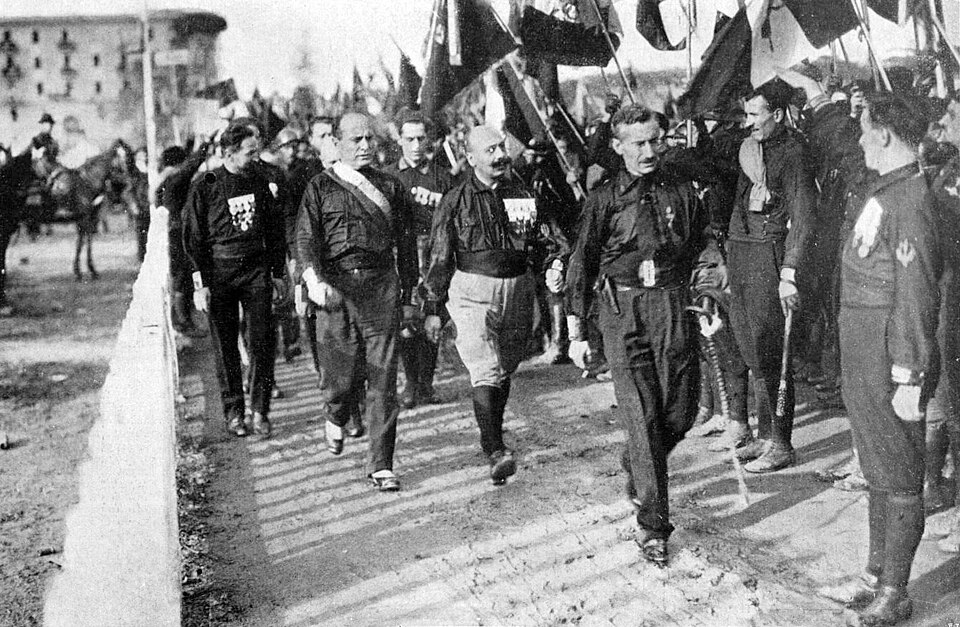
Key tactics:
| Method | Detail |
|---|---|
| Street violence | Squadrismo against socialists, 1920–1922 |
| Electoral performance | Fascists won 35 seats in 1921 coalition with Giolitti |
| Elite support | Funded by industrialists (Fiat’s Agnelli), landowners; tolerated by police/army |
| Propaganda | Mussolini’s newspaper Il Popolo d’Italia; cult of virility, action, the “new Italian” |
| Royal invitation | Victor Emmanuel III refused martial law and appointed Mussolini PM |
IB Tip: A strong “emergence” essay on Mussolini will argue that he won power not just through violence but through a combination of elite support and elite failure. The Italian establishment thought Mussolini could be tamed and used against the socialists — as with Hitler, the calculated misreading of a radical leader’s intentions by conservative elites was decisive.
Joseph Stalin and the Struggle for Succession
Stalin’s path to power was not a seizure of government (Lenin’s Bolsheviks had already done that in October 1917) but a struggle for dominance within the one-party state after Lenin’s death.
Lenin’s Death and the Succession Crisis (1924): Lenin died on 21 January 1924. His Testament (dictated December 1922–January 1923) warned the Party against Stalin — calling him “too rude” and recommending his removal as General Secretary. The Testament was suppressed; Stalin survived because rival factions each calculated he could be used against their enemies.
Stalin’s institutional base: As General Secretary of the Communist Party (appointed 1922), Stalin controlled the nomenklatura — the list of approved appointments to Party and state positions. He systematically packed committees, regional parties, and the Politburo with loyal appointees. This dry bureaucratic power was invisible to rivals focused on ideological debate.
Factional manoeuvres:
| Phase | Stalin’s Tactic | Opponents Defeated |
|---|---|---|
| 1923–1925 | Allied with Zinoviev and Kamenev against Trotsky | Trotsky marginalised, expelled 1927 |
| 1925–1927 | Allied with Bukharin (NEP faction) against Zinoviev-Kamenev | Zinoviev and Kamenev expelled 1927 |
| 1928–1929 | Turned against Bukharin (“Right Deviation”) | Bukharin expelled from Politburo 1929 |
Ideological weapon: Stalin developed the theory of “Socialism in One Country” (1924) — the USSR must build socialism alone, not wait for world revolution. This was more practical than Trotsky’s “permanent revolution” thesis and appealed to Russian nationalist sentiment within the Party.
By 1929, Stalin held supreme power. He was not yet the absolute dictator he would become after the purges (1936–1938), but no rival could challenge him.
Stalin’s power consolidation — Three key advantages:
- Institutional — General Secretary controlled all Party appointments (nomenklatura)
- Tactical — Played factions against each other; was underestimated as a “grey blur” by rivals
- Ideological — “Socialism in One Country” appealed over Trotsky’s internationalism after failed revolutions in Hungary, Germany, and elsewhere
1.4 Comparative Analysis: Conditions and Methods
Comparison Table — Conditions That Enabled Rise to Power:
| Condition | Hitler (Germany) | Mussolini (Italy) | Stalin (USSR) | Mao (China) | Castro (Cuba) |
|---|---|---|---|---|---|
| Economic crisis | Great Depression; 6.1m unemployed by 1933 | Post-war dislocation; Biennio Rosso 1919–1920 | Post-revolution/civil war economic collapse; NEP inequalities | Rural poverty; warlord extortion; GMD failure to industrialise | US-dominated sugar monoculture; Batista’s corruption; 35% rural poverty |
| Social division | Class tensions; fear of communism; anti-Semitism | Fear of socialist revolution; mutilated victory resentment | Class warfare rhetoric; peasant/proletarian tensions | Landlord–peasant gulf; 4% owned 50% of land; urban intellectual alienation | Sharp inequality; US companies owned 40% of sugar land; landless peasants |
| War impact | Defeat + Versailles; stab-in-the-back myth | ”Mutilated victory”; 600,000 dead for inadequate gains | WWI catastrophe; Brest-Litovsk humiliation; Civil War | Century of Humiliation; Japanese invasion 1937–45; Civil War 1927–49 | Cuban independence incomplete (US Platt Amendment, 1901); sense of unfulfilled revolution |
| Weak political system | Weimar Republic structural flaws; coalition paralysis | Liberal Italy’s trasformismo; unstable governments | Bolshevik one-party state with unresolved succession | Warlordism; GMD (KMT) unable to unify China; one-party KMT corruption | Batista’s coup 1952 destroyed electoral democracy; no legitimate path to change |
Comparison Table — Methods of Seizing Power:
| Method | Hitler | Mussolini | Stalin | Mao | Castro |
|---|---|---|---|---|---|
| Violence/coercion | SA intimidation; SA/SS street violence | Squadrismo; squad violence against socialists | Cheka/OGPU; Red Terror during Civil War | People’s Liberation Army (PLA); Long March builds military base; Civil War against GMD | Guerrilla campaign from Sierra Maestra 1956–59; 26th of July Movement |
| Propaganda | Goebbels; mass rallies; radio; film | Il Popolo d’Italia; Roman imagery; virility cult | ”Socialism in One Country”; cult of Lenin; Pravda | Mao Zedong Thought; peasant mobilisation; Long March mythology | Radio Rebelde broadcasts; “History will absolve me” speech (1953) |
| Ideology | National Socialism; race; anti-communism | Fascism; ultra-nationalism; anti-liberalism; corporatism | Marxism-Leninism; industrialisation imperative; class war | Sinicised Marxism; agrarian revolution; anti-imperialism; nationalism | Anti-imperialism; social justice; initially non-communist; adapts to Marxism-Leninism after 1959 |
| Elite/institutional support | Conservative elites; Hindenburg; industrialists | Victor Emmanuel III; Italian army inaction; industrialists | General Secretary control of nomenklatura | Peasant mass base; PLA loyalty; educated youth (CCP organisation) | Urban middle-class support initially; rural guerrillas; some Batista military defectors |
| Legal/electoral means | 37.4% vote (Jul 1932); appointed Chancellor Jan 1933 | 35 seats in 1921; invited to form government Oct 1922 | Intra-party manoeuvre; no democratic elections involved | No elections — armed revolution; GMD government delegitimised by corruption and military failure | No elections under Batista — coup had eliminated them; guerrilla war as only path |
Watch: Emergence and Rise to Power — All Three Leaders
Quick Recall — Section 1
Try to answer without scrolling up:
- Name three conditions that helped authoritarian leaders rise to power.
- How did the Weimar Republic’s weaknesses contribute to Hitler’s rise?
- What role did the Great Depression play in the rise of authoritarian states?
Reveal answers
- Economic instability (e.g. hyperinflation, Depression), weak democratic institutions, popular disillusionment with the existing political system, impact of WWI or national humiliation, and charismatic leadership/propaganda.
- Proportional representation created unstable coalition governments; Article 48 allowed rule by decree; the Weimar Republic was associated with the “Stab in the Back” myth and the Treaty of Versailles.
- Mass unemployment and poverty discredited democratic governments and made radical alternatives (Nazism, Fascism) attractive to desperate populations.
Section 2: Theme 2 — Consolidation and Maintenance of Power
2.1 From Office to Dictatorship — The Legal Path
Once in power, each leader used a combination of legal manoeuvre, manufactured crises, and institutional change to dismantle democratic constraints.
Hitler’s Consolidation, 1933–1934
When Hitler became Chancellor on 30 January 1933, he controlled only three of twelve Cabinet posts. Within eighteen months he had destroyed German democracy and held absolute power.
The Reichstag Fire (27 February 1933): A Dutch communist, Marinus van der Lubbe, set fire to the Reichstag building. Whether the Nazis were involved remains debated by historians (most now believe van der Lubbe acted alone). Hitler immediately used the fire to demand emergency powers. The Reichstag Fire Decree (28 February 1933) suspended civil liberties, authorised protective custody without trial, and allowed the Reich government to override state governments. Within days, thousands of communists and socialists were arrested.
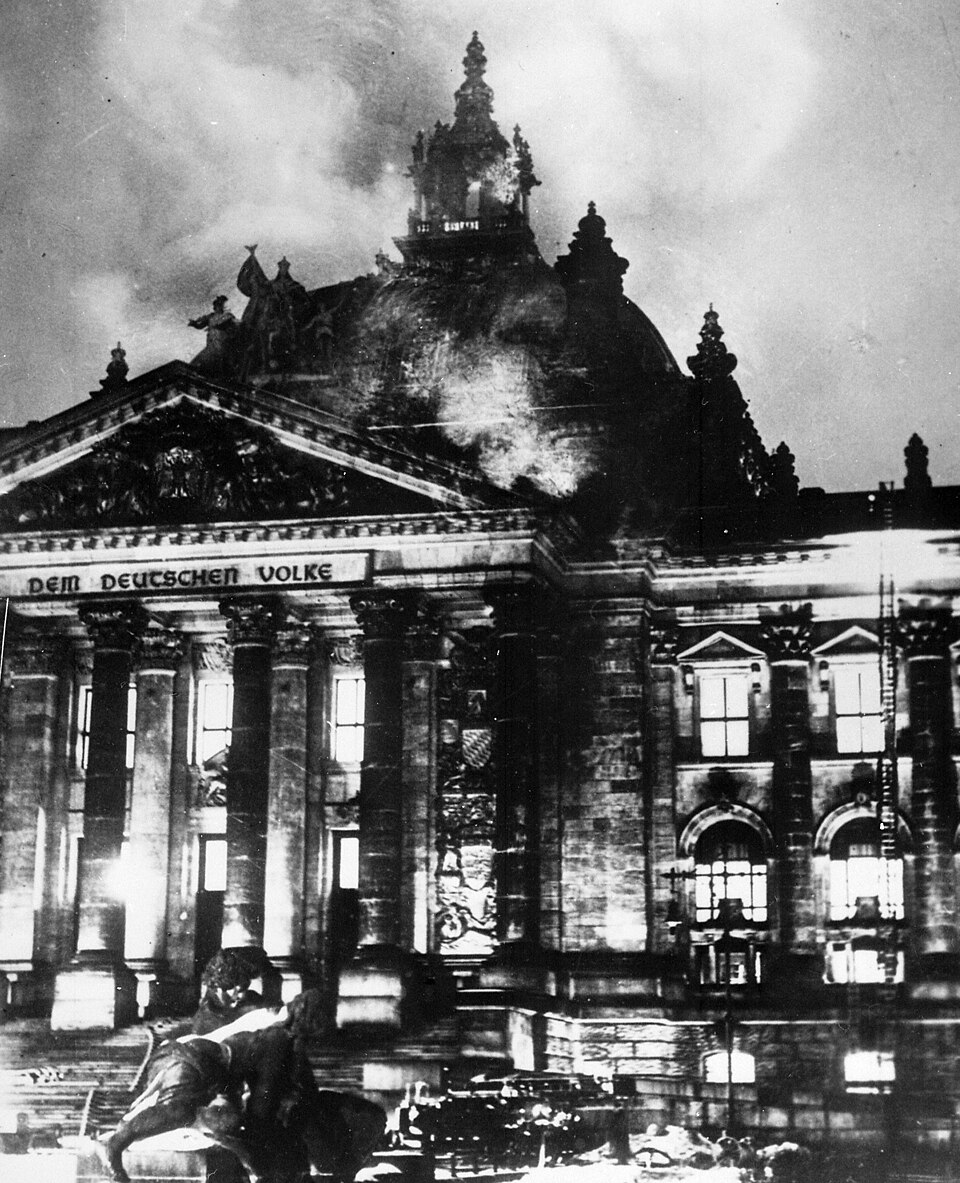
The March 1933 Elections: With the KPD (Communist Party) effectively suppressed and the SA intimidating voters, the Nazis won 43.9% — still not a majority. Hitler needed the Enabling Act to pass.
The Enabling Act (23 March 1933): The Law for the Relief of Distress of People and Reich (Ermächtigungsgesetz) gave Hitler the power to pass laws without Reichstag approval for four years. It required a two-thirds majority. The Nazis achieved this by:
- Arresting or intimidating KPD deputies (81 seats now missing)
- Striking a deal with the Centre Party (Catholic) by promising to protect Church rights (a promise he quickly broke)
- Holding the vote in the Kroll Opera House, surrounded by SA and SS
The SPD voted against — 94 deputies, the only party to do so. Their leader, Otto Wels, gave a defiant speech. It was the last free vote in the Reichstag under the Third Reich.
The Gleichschaltung (“Coordination”), March–July 1933:
- State (Länder) governments replaced by Nazi Reich Governors (March–April)
- Trade unions dissolved and replaced by the Nazi German Labour Front (DAF), May 1933
- All political parties banned — SPD banned June 1933; all others dissolved themselves by July 14, 1933
- Law Against the Formation of New Parties (14 July 1933) — Germany becomes a one-party state
The Night of the Long Knives (30 June – 2 July 1934): Hitler ordered the SS to murder the leadership of the SA (Sturmabteilung). Ernst Röhm, the SA chief, had been demanding that the SA absorb the regular army and continue the “social revolution” — threatening Hitler’s alliance with the army generals. The purge killed approximately 85–200 people (official figure was 77; the real number was higher), including Röhm, former Chancellor von Schleicher, and other political enemies. The army swore personal loyalty to Hitler in gratitude.
Death of Hindenburg (2 August 1934): When President Hindenburg died, Hitler merged the offices of President and Chancellor into the title of Führer und Reichskanzler. The army swore a personal oath of loyalty to Hitler rather than to Germany. The consolidation of power was complete.
Hitler’s consolidation sequence:
Jan 1933: Appointed Chancellor → Feb 1933: Reichstag Fire Decree (emergency powers) → Mar 1933: Enabling Act (four-year rule by decree) → Apr–Jul 1933: Gleichschaltung (state takeover, parties banned) → Jun 1934: Night of Long Knives (SA destroyed, army loyalty secured) → Aug 1934: Death of Hindenburg → Hitler becomes Führer
Mussolini’s Consolidation, 1922–1928
Mussolini’s consolidation was slower and more cautious than Hitler’s — he faced a stronger set of existing institutions (monarchy, Church, military, Senate) that could not be swept away immediately.
Initial Coalition Government (1922–1924): Mussolini began with a coalition cabinet including only four Fascists out of twelve ministers. He cultivated the image of a moderate statesman while building Fascist power beneath the surface.
The Acerbo Law (July 1923): This electoral reform law gave two-thirds of parliament to any party that won more than 25% of the vote. It guaranteed Fascist dominance in future elections. The law passed with support from non-Fascist parties who calculated the Fascists would not actually win 25%.
The 1924 Elections: Using the Acerbo Law, widespread intimidation by Fascist squads, and electoral fraud, the Fascist list won 66.3% — giving them 374 out of 535 seats.
The Matteotti Crisis (June–December 1924): Socialist MP Giacomo Matteotti gave a speech in parliament documenting evidence of Fascist electoral fraud and demanding the elections be annulled. On 10 June 1924, Matteotti was kidnapped and murdered by Fascist thugs (members of the Ceka, a Fascist secret service unit). This came very close to destroying Mussolini: opposition politicians staged the Aventine Secession, withdrawing from parliament in protest.
Why Mussolini survived: The king refused to dismiss him. The army and police remained loyal. The opposition’s strategy of withdrawal from parliament was ineffective — rather than forcing a crisis, it simply removed the opposition from the arena. By January 1925, Mussolini had decided on full dictatorship.
The January 1925 Speech: On 3 January 1925, Mussolini gave a speech to the Chamber of Deputies declaring personal responsibility for all Fascist violence — in effect a dare for anyone to challenge him. No one did. This speech marks the formal beginning of the Fascist dictatorship.
The Leggi Fascistissime (“Most Fascist Laws”), 1925–1926:
- Mussolini became Head of Government accountable only to the king, not parliament (December 1925)
- Press freedom abolished; newspaper editors required to be Fascist party members
- All opposition parties banned; free trade unions dissolved
- The OVRA (Organizzazione per la Vigilanza e la Repressione dell’Antifascismo) secret police established, 1927
- Special Tribunal for the Defence of the State (1926) — political crimes tried without jury
The Lateran Treaties (1929): Mussolini resolved the 60-year conflict between the Italian state and the Catholic Church, creating the Vatican City as an independent state and recognising Catholicism as Italy’s state religion. This gave him enormous prestige — even anti-Fascist Catholics were impressed — and secured Church support for the regime.
Exam Alert: Students often treat the March on Rome as the moment Mussolini established his dictatorship. It was not — it was the moment he became Prime Minister in a coalition government. The actual dictatorship was established between January 1925 and 1928. Many Paper 2 questions specifically ask about consolidation of power — make sure you distinguish between coming to power and consolidating dictatorship.
Stalin’s Consolidation, 1929–1939
By 1929, Stalin dominated the Party. But dominance within the Party and absolute totalitarian control were different things. The 1930s saw Stalin eliminate all potential rivals through terror and create a personal dictatorship unparalleled in modern history.
Show Trials and the Great Purge (1936–1938):
The Great Purge (Yezhovshchina — “time of Yezhov,” after NKVD chief Nikolai Yezhov) was a campaign of political repression that destroyed the entire old Bolshevik generation, gutted the Red Army leadership, and terrorised Soviet society into submission.
The Show Trials (1936–1938): Three major public trials:
- Trial of the Sixteen (August 1936): Zinoviev, Kamenev, and 14 others tried for “terrorist conspiracy” — executed
- Trial of the Seventeen (January 1937): Radek, Pyatakov, and others — 13 executed
- Trial of the Twenty-One (March 1938): Bukharin, Rykov, Yagoda — all executed
Defendants made implausible confessions to treasonous conspiracies with foreign powers. The confessions were extracted through sleep deprivation, threats to family members, and false promises of leniency. Western observers at the trials were often deceived into believing the confessions were genuine.
Military Purge (1937): The Red Army officer corps was devastated:
- 3 of 5 Marshals shot
- 13 of 15 Army Commanders shot
- 50 of 57 Corps Commanders shot
- approximately 35,000–40,000 officers removed from their posts (executed, imprisoned, or dismissed)
The Gulag system: The NKVD ran a vast network of forced-labour camps (the Gulag Archipelago, in Solzhenitsyn’s phrase). Between 1934 and 1953, approximately 18 million people passed through the Gulag system; estimates of deaths from overwork, starvation, and execution range from 1.5 to 1.8 million within the camps, with additional millions dying in transit.
The 1936 “Stalin Constitution”: This new Soviet constitution was one of the most democratic-sounding documents ever written — it guaranteed freedom of speech, press, assembly, and inviolability of persons. In practice it was meaningless: the Communist Party maintained its monopoly on power, and the rights were never enforced. The constitution served propaganda purposes — demonstrating to the world that the USSR was a legitimate state.
IB Tip: The contradiction between the 1936 Constitution and the simultaneous Great Purge is a powerful analytical point. It shows that Stalin understood the value of democratic legitimacy as propaganda while having zero intention of allowing it in practice. This contradiction — between form and reality — is central to all three regimes’ maintenance of power.
2.2 Terror, Coercion, and the Security State
Each regime maintained a parallel security apparatus that operated outside normal legal constraints.
| Instrument | Germany | Italy | USSR | China (Mao) | Cuba (Castro) |
|---|---|---|---|---|---|
| Secret police | Gestapo (formed 1933; Himmler 1936) + SS | OVRA (1927); Ceka (1923) | Cheka → GPU → OGPU → NKVD → KGB | Ministry of Public Security; People’s Liberation Army political commissars | G2 intelligence service; Committees for the Defence of the Revolution (CDRs) |
| Political courts | People’s Court (Volksgerichtshof) | Special Tribunal for Defence of the State | Military tribunals; troika courts | Revolutionary tribunals; mass public trials during campaigns | Revolutionary tribunals; summary justice for Batista collaborators |
| Camps | Concentration camps (Dachau opened March 1933) | Confino (internal exile); few camps | Gulag — 476 camp complexes by 1940 | Laogai (reform through labour) camps — est. 10 million passed through by 1980 | UMAP camps (1965–68) for “social deviants” — homosexuals, priests, dissidents |
| Scope of terror | Targeted (Jews, communists, Sinti/Roma, dissidents) | Limited by European standards; estimated 4,596 sentenced 1926–1943 | Mass — estimated 1.5m executed 1936–1938; millions more in Gulag | Mass — Land Reform (1m+ executed 1949–52); Anti-Rightist Campaign (500,000+ sent to camps); Cultural Revolution (est. 500,000–2m deaths) | Moderate by comparison — thousands imprisoned, some executions; large-scale emigration (1m+ left Cuba) |
Exam Alert: Italian Fascism was significantly LESS violent than Nazism or Stalinism in terms of internal repression. The OVRA had approximately 1,000 full-time agents, and the Special Tribunal sentenced fewer than 5,000 people in its entire existence. Students who treat all three regimes as equally terrifying misrepresent the evidence. This distinction also matters for “to what extent” questions about Mussolini’s control — he relied more on consent than the other two.
2.3 Propaganda, Personality Cults, and Censorship
Maintaining power required not just fear but also manufactured consent — getting people to believe, or at least appear to believe, in the regime.
Nazi Germany
Joseph Goebbels as Reich Minister for Public Enlightenment and Propaganda (1933) controlled all media in Germany:
-
Radio: 70% of German households had a radio by 1939 (the Volksempfänger or “people’s receiver” sold cheaply). Radio broadcasts brought Hitler’s speeches directly into homes
-
Film: Leni Riefenstahl’s Triumph of the Will (1935) aestheticised the Nazi rally and projected Hitler as messianic. Newsreels preceded every cinema programme
-
Nuremberg Rallies: Annual mass spectacles of hundreds of thousands, choreographed to create the impression of irresistible national unity
-
Press: All newspapers coordinated through the Reich Press Chamber; editors were legally responsible for political reliability
-
Hitler Youth and BDM: From age 10, children were enrolled in state youth organisations that inculcated Nazi ideology and loyalty to the Führer
The Hitler Myth (Ian Kershaw): Historian Ian Kershaw argued that Hitler maintained power partly through a carefully constructed image of infallibility — people blamed problems on subordinates, not Hitler. “If only the Führer knew” was a common phrase among Germans who complained about specific Nazi policies.
Fascist Italy
Mussolini was the first modern leader to use mass media for a personality cult. His image saturated Italy:
- The phrase “Mussolini ha sempre ragione” (“Mussolini is always right”) was stencilled on walls across Italy
- His name was incorporated into the Roman greeting — the Fascist salute and “Duce” (Leader)
- Cinema newsreels (the Luce Institute, founded 1924) promoted Fascist achievements
- Mussolini carefully cultivated his image as simultaneously the warrior, the intellectual, the farmer, the athlete — the “new Renaissance man”
- However, the Catholic Church retained significant cultural influence, limiting Fascist totalising ambitions
Stalin’s USSR
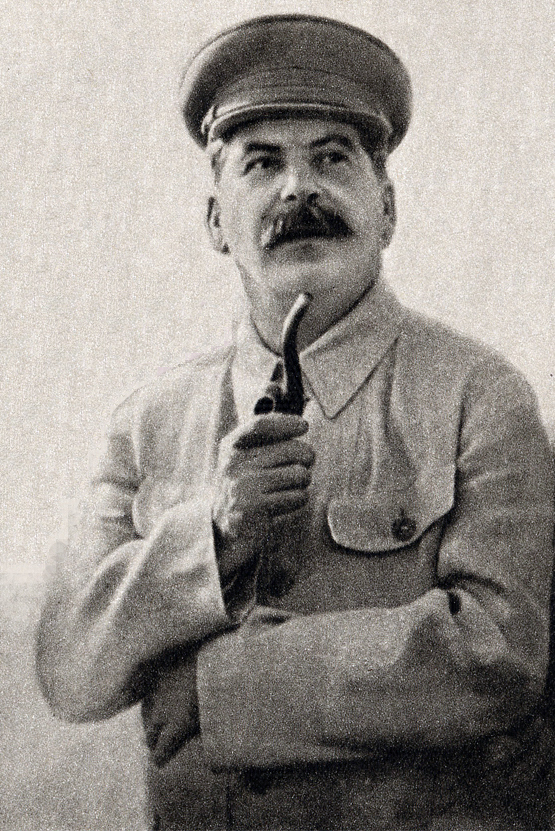
Stalin’s cult was the most extreme of the three:
- Stalin as Lenin’s true heir: After Lenin’s death, Stalin controlled the construction of the Lenin cult, positioning himself as its guardian and ideological successor
- “Uncle Joe” to the peasants, the intellectual Marxist in foreign policy — Stalin had multiple images for different audiences
- Socialist Realist art (mandated from 1934): all art and literature had to present the world optimistically and realistically, glorifying Soviet achievements and Party leaders. Modernism, abstraction, and complexity were banned
- The History of the All-Union Communist Party (Short Course) (1938): a rewritten history of the Party that erased the contributions of all purged figures and elevated Stalin’s role in every event since 1917
- Censorship was total: the NKVD monitored letters, phone calls, and informers reported private conversations. Writers, artists, and scientists who produced ideologically incorrect work faced arrest
Propaganda tools by regime — quick reference:
| Tool | Germany | Italy | USSR | China (Mao) | Cuba (Castro) |
|---|---|---|---|---|---|
| Mass rallies | Nuremberg Rallies (annual) | Fascist spectacles; Roman imagery | May Day parades; Red Square events | Mass mobilisation campaigns; Tiananmen Square rallies during Cultural Revolution | Plaza de la Revolucion rallies; Castro’s marathon speeches (record: 7 hours 10 minutes, 1986) |
| State media | Goebbels’ Ministry; Volksempfänger radio | Luce Institute newsreels; Il Popolo | Pravda; TASS; Socialist Realism mandate | People’s Daily (Renmin Ribao); Xinhua state news agency; Mao’s poems broadcast as art | Granma (official party newspaper); Radio Rebelde; ICRT state broadcasting |
| Cult image | Hitler as messianic saviour | Mussolini as warrior-intellectual | Stalin as Lenin’s heir; “Father of Peoples” | Mao as “Great Helmsman,” “Great Teacher,” father of the nation; The Little Red Book (700m+ copies) | Castro as guerrilla hero; beard and olive fatigues as brand; David vs. Goliath anti-US narrative |
| Youth indoctrination | Hitler Youth (HJ) and League of German Girls (BDM) | Opera Nazionale Balilla (ONB) | Komsomol (Communist Youth League); Young Pioneers | Communist Youth League; Red Guards during Cultural Revolution (teenagers used as shock troops) | Union of Young Communists (UJC); mass literacy and education campaigns tied to revolutionary loyalty |
| Cultural control | Reich Chamber of Culture | Ministry of Popular Culture (MinCulPop) | Union of Soviet Writers; Socialist Realism | Ministry of Culture; “art serves the workers”; Cultural Revolution destroyed all pre-revolution culture | ICAIC (Cuban film institute) — films must serve the revolution; national cultural identity celebrated |
2.4 Treatment of Opposition
Germany — The Night of the Long Knives and Political Opponents
By June 1934, Hitler had effectively destroyed organised opposition through the Gleichschaltung and the Enabling Act. The Night of the Long Knives (30 June–2 July 1934) eliminated the one internal threat that remained: the SA leadership under Ernst Röhm.
Political opposition post-1933:
- The SPD operated in exile (SOPADE) from Prague and Paris, sending agents back into Germany. Its reports (the Deutschland-Berichte) are important historical sources for genuine popular opinion under Nazism
- The KPD (Communist Party) continued underground cells; thousands were arrested by the Gestapo in 1933–1934
- The White Rose (Hans and Sophie Scholl, Munich, 1942–1943) distributed anti-Nazi leaflets; both were executed
- The July 20 Plot (1944): Senior Wehrmacht officers planted a bomb under Hitler’s conference table. Hitler survived; approximately 4,980 people were executed in the aftermath
Historian debate — was resistance possible? Robert Gellately (Backing Hitler, 2001) argued the Gestapo relied heavily on denunciations by ordinary Germans rather than a large surveillance network. The Gestapo had only about 7,000 full-time officers for 80 million people — it worked because Germans informed on each other. This view challenges the image of all-seeing totalitarian surveillance.
Italy — The Matteotti Affair and After
After the Matteotti Crisis and the 1925 dictatorship, organised opposition was broken:
- Antonio Gramsci, leader of the Italian Communist Party, was arrested in 1926 and sentenced to 20 years. He wrote his famous Prison Notebooks in captivity; died in prison in 1937
- Most opposition operated in exile: the Giustizia e Libertà movement (Carlo Rosselli, Paris) organised clandestine anti-fascist activity
- Compared to Germany and the USSR, Italian Fascism tolerated a greater degree of private dissent — the regime controlled public behaviour more than private belief
USSR — The Great Purge and its Targets
The Great Purge was not limited to old Bolsheviks:
- Party members: 1.2 million expelled from the Party 1936–1938; hundreds of thousands arrested
- Military: The devastating officer purge on the eve of WWII
- Ordinary citizens: The NKVD had execution quotas by region — regional officers competed to exceed them. An estimated 750,000–800,000 people were shot in 1937–1938 alone
- National minorities: Mass deportations of “suspect” nationalities — Koreans from the Far East (1937), Poles, Germans, Finns within the USSR
- Kulaks: During collectivisation (1929–1933), “kulak” (wealthy peasant) was used as a category to justify deportation and execution of millions of peasants who resisted collectivisation
2.5 Foreign Policy and the Maintenance of Power
Foreign policy is occasionally tested directly in Topic 10 (especially “to what extent did the aims of authoritarian leaders determine their foreign policy?”), but more commonly it appears as context for other questions — especially about economic policy (rearmament, autarky) and the maintenance of power (using foreign success to generate domestic support).
Nazi Germany’s Foreign Policy
Hitler’s foreign policy followed the ideological programme he had laid out in Mein Kampf:
- Destroy the Treaty of Versailles
- Unite all ethnic Germans (Anschluss, Sudetenland)
- Conquer Lebensraum in the East
- Destroy “Judeo-Bolshevism” (the USSR)
Chronology of escalating aggression:
| Date | Event | Significance |
|---|---|---|
| Oct 1933 | Withdrawal from League and Disarmament Conference | First move to escape Versailles constraints |
| Mar 1935 | Rearmament announced; conscription reintroduced | Open violation of Versailles; no military response from West |
| Jun 1935 | Anglo-German Naval Agreement | Britain undermines Versailles unilaterally |
| Mar 1936 | Remilitarisation of the Rhineland | The crucial gamble — France and Britain did not resist |
| Oct 1936 | Rome-Berlin Axis | Diplomatic alignment with Italy |
| Nov 1936 | Anti-Comintern Pact (Germany + Japan) | Ideological anti-Soviet coalition |
| Mar 1938 | Anschluss — Austria absorbed | ”Greater Germany” created; Versailles finally dead |
| Sep 1938 | Munich Agreement — Sudetenland ceded | Western appeasement at its peak; Czechoslovakia betrayed |
| Mar 1939 | Occupation of remainder of Czechoslovakia | Hitler breaks his promise; Western appeasement ends |
| Aug 1939 | Molotov-Ribbentrop Non-Aggression Pact | Tactical agreement to avoid two-front war in first phase |
| Sep 1939 | Invasion of Poland | WWII begins |
Key numbers to remember:
- 6 territorial moves in 4 years (1935–1939), each one larger and more aggressive than the last
- Rhineland (1936) — Hitler’s own generals feared French resistance; France did not respond; this was the moment to stop him
- Munich (Sep 1938) — Chamberlain’s “peace in our time”; Sudetenland ceded; Czechoslovakia abandoned without being consulted
- March 1939 — Czechoslovakia occupied in full; Western appeasement policy collapses; war guarantees given to Poland
The role of foreign policy success in maintaining domestic power:
Foreign policy victories were essential to Hitler’s domestic popularity:
- Reoccupation of the Rhineland (1936): celebrated as the end of Versailles humiliation
- Anschluss (1938): 99% vote in plebiscite (the figure was inflated by intimidation but genuine enthusiasm was high)
- Munich (1938): Hitler received a hero’s welcome in Germany — acquiring the Sudetenland without a shot fired seemed to confirm his genius
IB Tip: Foreign policy success was a tool of domestic legitimacy for Hitler. This is a key element of Theme 2 — consolidation and maintenance of power. When writing about how Hitler maintained power, foreign policy achievements belong in the answer alongside propaganda and terror.
Fascist Italy’s Foreign Policy
Mussolini’s foreign policy ambitions centred on making Italy a great power — dominating the Mediterranean (“Mare Nostrum” — “our sea”), establishing an African empire, and exercising influence in the Balkans and Danube basin.
Key events:
| Date | Event | Significance |
|---|---|---|
| 1923 | Corfu Incident — Italy briefly occupied Greek island | Early display of Fascist assertiveness; League complaint dismissed |
| 1924 | Annexation of Fiume | Satisfied nationalist demand; strengthened domestic position |
| 1935–1936 | Conquest of Abyssinia (Ethiopia) | Major domestic triumph; League imposed sanctions but ineffectively |
| 1936 | Rome-Berlin Axis | Alliance with Hitler; Mussolini increasingly in Germany’s orbit |
| 1936–1939 | Intervention in Spanish Civil War | 70,000+ troops supporting Franco; costly and inconclusive |
| 1939 | Invasion and annexation of Albania | Showed Italy could act independently of Germany |
| 1939 | Pact of Steel with Germany | Full military alliance |
| Jun 1940 | Italy enters WWII against France and Britain | Disastrous miscalculation — Italian military proved inadequate |
The Abyssinian Crisis as a turning point: The League of Nations imposed sanctions on Italy in 1935–1936, which pushed Mussolini toward closer alignment with Hitler. Before the Abyssinia crisis, Mussolini had actually been a potential brake on Hitler (the Stresa Front, April 1935, briefly united Britain, France, and Italy against German rearmament). The sanctions destroyed this potential coalition.
Exam Alert: The Abyssinian conquest (1935–1936) was initially celebrated in Italy as a great victory — Mussolini declared the restoration of the Roman Empire. But it had devastating long-term consequences: it ended the Stresa Front, brought Italy into Hitler’s orbit, exposed the League as toothless, and drew Italian resources into an expensive colonial adventure. Good essays distinguish between short-term domestic success and long-term strategic damage.
Stalin’s Foreign Policy
Stalin’s foreign policy was driven by two overriding concerns: prevent encirclement of the USSR by capitalist/fascist powers and buy time for Soviet industrialisation.
Key phases:
-
1933–1935 (Collective Security): After Hitler’s rise, the USSR sought alliances with France and Britain. The USSR joined the League of Nations (1934), signed a Franco-Soviet Pact (1935). Stalin supported “Popular Front” governments against fascism.
-
1936–1938 (Spanish Civil War): The USSR provided arms and advisers to the Spanish Republic — but also used Spain to eliminate Trotskyist and anarchist groups within the Republican movement (NKVD operations).
-
1938 (Munich betrayal): The USSR was excluded from the Munich Conference, confirming Stalin’s fear that Britain and France would attempt to direct German aggression eastward. This fundamentally changed Soviet foreign policy calculations.
-
August 1939 (Molotov-Ribbentrop Pact): Stalin’s tactical masterstroke — or catastrophic gamble. By agreeing non-aggression with Hitler, the USSR: bought 22 months to prepare for war; acquired eastern Poland, the Baltic States, and Bessarabia under the secret protocol; forced Hitler to fight the West first. The gamble failed on June 22, 1941 (Operation Barbarossa).
The logic of the Molotov-Ribbentrop Pact:
Mutual distrust of Britain and France after Munich → Stalin needs time for military rebuilding after the officer purges → Non-aggression with Hitler buys 22 months + territorial buffer → But Hitler attacks anyway on June 22, 1941 → 27 million Soviet dead
The pact was both rational (given Stalin’s fears) and catastrophic (it failed and gave Hitler strategic advantage).
Watch: Consolidation of Power — Dictatorship in Practice
Quick Recall — Section 2
Try to answer without scrolling up:
- Name two methods Hitler used to consolidate power between 1933 and 1934.
- What role did propaganda and censorship play in maintaining authoritarian rule?
- How did Stalin’s purges help him consolidate power?
Reveal answers
- The Reichstag Fire Decree (suspending civil liberties), the Enabling Act (allowing rule by decree), the Night of the Long Knives (eliminating SA leadership), and merging Chancellor and President roles after Hindenburg’s death.
- Propaganda created a cult of personality and controlled public opinion; censorship eliminated opposition voices, creating the illusion of unanimous support.
- The purges eliminated real and perceived rivals, terrorised the population into obedience, and allowed Stalin to replace experienced leaders with loyal followers.
Section 3: Theme 3 — Aims and Results of Policies
3.1 Economic Policies
Nazi Germany — The Four Year Plan and Economic Recovery
Hitler’s economic goals were twofold and interlinked: achieve full employment to demonstrate Nazi success, and rearm Germany at maximum speed for the wars he intended to launch.
Hjalmar Schacht and the “economic miracle” (1933–1936): As President of the Reichsbank and Economics Minister, Schacht used deficit financing (Mefo bills — a financial trick to hide rearmament spending from international creditors), import controls, and public works to reduce unemployment:
- Unemployment: 6.1 million (January 1933) → 1.6 million (1936) → virtual full employment by 1938
- Major public works: the Autobahn (motorway network), housing construction, land reclamation
The Four Year Plan (1936–1940): Announced in 1936 under Hermann Göring, this plan prioritised military rearmament and autarky (economic self-sufficiency):
- Expand synthetic rubber (Buna) and synthetic oil production to reduce dependence on imports
- Build up steel, aluminium, and armaments production
- Goal: Germany ready for war within four years
Limits of the economic recovery:
- Real wages grew slowly; consumers were squeezed by high armament spending
- Germany was never fully autarkic — it remained dependent on Swedish iron ore, Romanian oil, and other imports
- Schacht resigned in 1937, alarmed by the pace of rearmament spending; Göring took over
Exam Alert: Nazi economic recovery was real — unemployment did collapse — but many students exaggerate its breadth. Rearmament and public works were primarily responsible, not free-market reform. Germany’s economy was placed on a war footing from 1936 and the “miracle” was funded by debt. By 1939, Germany faced a looming fiscal crisis that made war economically attractive as a means of acquiring resources through conquest.
Key numbers to remember:
- 1.25 million unemployed (1928) — the pre-Depression baseline
- 6 million unemployed (January 1933) — the figure Hitler inherited; his economic “miracle” was built against this starting point
- 2.7 million (1934) — rapid early fall driven by rearmament and public works, not organic recovery
- Near zero (1938) — official figure, but women re-entering work, Jewish workers dismissed, and conscripts removed from count; the real number was higher
Fascist Italy — The Corporate State and Economic Nationalism
Mussolini’s economic ideology was the Corporate State — a “third way” between capitalism and communism in which the state, employers, and workers would be organised into 22 Corporations covering each sector of the economy, coordinating production and resolving labour disputes without class conflict.
In practice, the Corporate State never worked as advertised:
- The Corporations were dominated by employers and the Fascist party bureaucracy; workers had no genuine representation
- Real wages fell significantly in the early 1930s — the industrial workforce absorbed the costs of Italy’s economic nationalism
Key economic campaigns:
- “Battle for Grain” (Battaglia del Grano, 1925): Tariffs on imported grain; massive promotion of Italian wheat production. Result: grain self-sufficiency roughly achieved, but at enormous cost — farmers shifted from profitable crops to wheat, undermining Italy’s comparative advantages
- “Battle for Land” (Bonifica Integrale): Drainage of the Pontine Marshes; land reclamation; presented as Fascist triumph over nature
- The “Battle for the Lira” (Quota 90, 1926): Mussolini fixed the lira exchange rate at 90 to the pound (a significant overvaluation) for reasons of national prestige. This hurt Italian exports severely and forced deflation, reducing workers’ real wages
- Autarky from 1935: After League sanctions following the invasion of Abyssinia, Italy pursued greater self-sufficiency, but the Italian economy was too small and resource-poor for genuine autarky
Assessment: Italian industry grew modestly in the Fascist period, but the south remained underdeveloped, and real wages for industrial workers were lower in 1939 than in 1922. The corporate state was largely a bureaucratic fiction.
Stalinist USSR — Collectivisation and the Five Year Plans
Stalin’s economic transformation was the most radical and brutal of the three, amounting to a second revolution compressed into a decade.
Collectivisation (1929–1933): Stalin decided to end the NEP and collectivise Soviet agriculture — force peasants into collective farms (kolkhozy) to extract grain surpluses for export (to finance industrialisation) and feed the growing industrial workforce.
The dekulakisation campaign: “Kulaks” (defined loosely — essentially any peasant who resisted) were classified into three categories: the “hard core” to be shot, the less dangerous to be deported to Siberia, the rest to be expelled from their villages. Between 1930 and 1933, approximately 1.8 million families were deported; death tolls in transit and in special settlements are estimated at several hundred thousand.
The Ukrainian Famine (Holodomor, 1932–1933): When grain procurement quotas were maintained despite harvest failure, 3.5–7 million people died of famine in Ukraine (figures disputed; Ukrainian government estimates are higher). The Ukrainian Soviet leadership was purged; grain exports continued while Ukrainians starved. Whether the Holodomor constitutes genocide remains one of the most contested questions in 20th-century historiography.
Key numbers to remember:
- 3.5–7 million deaths in Ukraine alone (1932–1933) — the range reflects ongoing historiographical dispute; Ukrainian sources use higher figures
- Kharkiv oblast: approximately 29% of population died — the most severely affected region
- Kazakhstan lost an estimated 38% of its entire Kazakh population; approximately 1.5 million dead
- Grain exports continued throughout the famine: the USSR exported 1.73 million tonnes of grain in 1932 while millions starved
The Five Year Plans:
| Plan | Period | Priority |
|---|---|---|
| First | 1928–1932 | Heavy industry — coal, steel, pig iron; build Magnitogorsk |
| Second | 1933–1937 | Consolidate heavy industry; expand railways; some consumer goods |
| Third | 1938–1941 (interrupted by war) | Military-industrial complex; accelerated weapons production |
Results of industrialisation:
- Steel production: 4 million tonnes (1928) → 18.3 million tonnes (1940)
- Coal production: 35 million tonnes (1928) → 166 million tonnes (1940)
- Industrial output roughly tripled in the 1930s
- The USSR’s industrial capacity made it possible to outproduce Nazi Germany in tanks, aircraft, and artillery by 1942–1943
Key numbers to remember:
- Coal: 35 million tonnes (1928) → 128 million tonnes (1937) — a 3.7-fold increase in nine years
- Steel: 4 million tonnes (1928) → 18 million tonnes (1937) — a 4.5-fold increase; made Soviet WWII production possible
- Electricity: 5 billion kWh (1928) → 36 billion kWh (1937) — essential foundation for industrial modernisation
- The human cost: collectivisation famine killed 5–8 million; Gulag system provided forced labour as an industrial input
The human cost:
- Collectivisation killed an estimated 5–8 million people through famine, deportation, and execution
- Workers in industrial cities faced extreme deprivation — housing shortages, rationing, brutal labour discipline (the Stakhanovite movement imposed intensified quotas)
IB Tip: In a comparative essay on economic policies, a sophisticated argument is that all three regimes achieved short-term economic transformation at massive human cost but that Stalin’s transformation was categorically the most brutal. Hitler used market mechanisms alongside state direction; Mussolini’s corporate state was mostly theatre. Stalin destroyed the entire existing agricultural order and replaced it by force.
3.2 Social Policies — Women, Youth, and Minorities
Women and Gender Policy
Gender policy is one of the most heavily examined themes under “social policies” (Paper 2 World History Topic 10). It rewards comparative analysis because every authoritarian regime of the 20th century claimed to be reshaping the role of women, yet the rhetoric and the lived reality often diverged sharply. The shared paradox: all five regimes — fascist and communist alike — instrumentalised women for state goals (population, labour, ideological legitimacy), regardless of whether their stated ideology was natalist-traditionalist or revolutionary-egalitarian.
The central contradiction to grasp:
- Fascist regimes (Nazi Germany, Fascist Italy) framed women as mothers and wives in nationalist-natalist terms — yet economically conscripted them into the workforce as labour shortages bit, especially after rearmament
- Communist regimes (Stalinist USSR, Mao’s China, Castro’s Cuba) proclaimed legal-rhetorical gender equality and brought women into mass labour and public life — yet retreated on family policy when state demographic goals required it (Stalin 1936), and left patriarchal social structures and the “double burden” largely intact
Nazi Germany — Kinder, Küche, Kirche:
The Nazi ideal was encapsulated in the phrase “Kinder, Küche, Kirche” (Children, Kitchen, Church). Women were defined as biological reproducers of the racial nation. Key policies:
- Marriage loans (June 1933): interest-free loans of 1,000 Reichsmarks to couples where the woman left paid employment; one quarter was forgiven for each child born (four children cancelled the loan entirely)
- Mother’s Cross (Mutterkreuz, instituted 1938): Bronze for 4 children, Silver for 6, Gold for 8 — awarded on 12 August, Hitler’s mother’s birthday
- Lebensborn programme (1935): SS-run maternity homes for “racially valuable” mothers, including unmarried mothers of “Aryan” children
- Women progressively excluded from senior posts: married women dismissable from the civil service (under provisions of the 1933 Civil Service Law); women barred from serving as judges and prosecutors; a 10% female quota imposed on university admissions (1933) and tightened in the medical and legal professions
- League of German Girls (Bund Deutscher Mädel, BDM) socialised girls in domesticity, fitness, and Nazi ideology
- NS-Frauenschaft (Nazi Women’s League) under Gertrud Scholtz-Klink (Reichsfrauenführerin from 1934) channelled women into approved organisations
- Birth rate rose from 14.7 per 1,000 (1933) to roughly 20.3 per 1,000 by 1939 — but this also reflected economic recovery, not just ideology
- The contradiction: from 1937 onward, rearmament and the Four-Year Plan created acute labour shortages. Women were progressively drawn back into industry, and during WWII conscripted into war production — the ideology of female domesticity was overridden by the demands of total war
Fascist Italy — the Battle for Births:
Mussolini wanted to transform Italy from “40 million Italians” to “60 million by 1950” — a demographic basis for empire and military power. Gender policy served this demographic-imperial goal:
- Battle for Births (Battaglia delle Nascite), launched in the Ascension Day Speech of May 1927: tax incentives for large families; the bachelor tax (Tassa sul Celibato, 1926) penalised unmarried men aged 25–65
- ONMI (Opera Nazionale per la Maternità e l’Infanzia, founded 1925): state maternity and infant welfare bureau; clinics, milk distribution, prenatal care
- 1938 quota law: women limited to 10% of jobs in public administration and large private firms
- Fasci Femminili and the Massaie Rurali (rural housewives’ organisation, 1934) mobilised women into Fascist-approved roles
- The contradiction: despite all incentives, the Italian birth rate continued to fall through the Fascist period (from ~30 per 1,000 in 1922 to ~23 per 1,000 by 1936). Industrialisation, urbanisation, and economic hardship outweighed Fascist propaganda — the policy is widely judged a failure on its own terms
Stalinist USSR — equality, retrenchment, and the double burden:
Women in the USSR experienced the sharpest policy reversal of any of the five regimes. Early Bolshevism had been radically egalitarian; Stalinism partially rolled this back when demographic and stability concerns arose:
- The 1917 Revolution granted women full legal equality, civil marriage, and equal pay; the 1918 Family Code legalised easy divorce; abortion legalised 1920 (the world’s first state to do so)
- The Zhenotdel (Women’s Section of the Communist Party, 1919–1930), led by figures including Alexandra Kollontai, organised women’s emancipation; it was abolished in 1930 — Stalin declared the “woman question” solved
- The 1936 Family Code marked a sharp retreat: abortion recriminalised (except for medical necessity), divorce made expensive and bureaucratic, motherhood glorified, large-family bonuses introduced, and a tax on childlessness imposed; the Mother Heroine title (for 10+ children) and Order of Maternal Glory would follow in the 1944 Family Code
- Yet the demands of the Five-Year Plans pulled women into industry on a massive scale — by 1940 women were roughly 39% of the industrial workforce (up from 24% in 1928), and over half of all collective farm labour
- Women genuinely entered the professions: women became a substantial share of Soviet doctors and engineers (and by the post-war period a majority of physicians); in WWII, the 588th Night Bomber Regiment (“Night Witches”) flew over 30,000 combat sorties
- The double burden (“second shift”): women worked full-time in industry and retained primary domestic responsibility — childcare, queuing, housework. Soviet “equality” was real in the workplace but stalled at the kitchen door
Mao’s China — “Women hold up half the sky”:
Maoist gender policy combined genuine legal-revolutionary breakthroughs with continued rural patriarchy and instrumentalised mass mobilisation:
- The 1950 Marriage Law — one of the first major acts of the PRC — banned arranged marriage, child betrothal, concubinage, and bride-price; legalised divorce on grounds including incompatibility; established free choice of spouse. In a society where arranged marriage had been near-universal, this was revolutionary on paper
- Foot-binding — already in decline — was eradicated under the new regime
- The slogan “Women hold up half the sky” (妇女能顶半边天) became central propaganda; women were mobilised into agricultural production brigades (especially during the Great Leap Forward, 1958–62) and later industrial work units
- The All-China Women’s Federation (ACWF, founded 1949) was the official mass organisation channelling women’s political life — supportive of women’s rights within Party limits, but never permitted to organise autonomous feminism
- During the Cultural Revolution (1966–76), gender difference was rhetorically erased: identical Mao suits, women in Red Guard units, propaganda images of women in male-coded roles (operating tractors, soldiers). Yet leadership at the top remained overwhelmingly male
- The persistence of patriarchy: in rural areas, the 1950 Marriage Law was unevenly enforced — many women who sought divorce faced violent reprisal from in-laws; lineage and son-preference structures survived. Historians (e.g., Gail Hershatter) emphasise this gap between national policy and village reality
Castro’s Cuba — Federation of Cuban Women and the 1975 Family Code:
Cuban gender policy is, in absolute terms, the most successful of the five regimes on conventional measures of female advancement — but it operated under one-party rule and never permitted independent feminism:
- Federation of Cuban Women (Federación de Mujeres Cubanas, FMC), founded August 1960 under Vilma Espín (Raúl Castro’s wife) — a mass organisation that by the 1980s claimed over 80% of adult Cuban women as members; ran daycare, training, and political education
- 1961 Literacy Campaign — half of the 100,000+ youth literacy brigadistas (brigadistas) were female; the campaign brought adult literacy from ~76% to ~96% within a year, with women among the largest beneficiaries
- Abortion effectively legalised by ministerial regulation in 1965 (free, on request); among the most liberal regimes globally on reproductive access
- 1975 Family Code: legally required shared housework between spouses — the first state to do so. Symbolically powerful even if patchily enforced
- Women’s labour-force participation rose from ~13% (1959) to roughly 38% by 1989; women became a majority of doctors, teachers, and judicial officials
- The contradiction: despite formal equality, machismo persisted in social life — by the 1980s the FMC itself was openly debating the gap between legal equality and lived experience. As elsewhere, the regime tolerated no autonomous feminist movement outside the FMC
Comparative table: women and gender policy across the five regimes
| Regime | Ideological aim | Key policies / instruments | Labour role | Reproductive policy | Outcome (rhetoric vs. reality) |
|---|---|---|---|---|---|
| Nazi Germany | Racial-natalist; women as biological reproducers of the Volk | Marriage loans (1933); Mutterkreuz (1938); Lebensborn (1935); BDM; NS-Frauenschaft (Scholtz-Klink) | Pushed out of professions 1933–37; conscripted back into industry during rearmament and WWII | Strongly pro-natalist for “Aryans”; forced sterilisation (1933 Law) and abortion for those deemed “unfit” | Birth rate rose, but ideology collapsed under wartime labour demand |
| Fascist Italy | Demographic-imperial natalism (“60 million by 1950”) | Battle for Births (1927); bachelor tax (1926); 10% quota (1938); ONMI (1925); Fasci Femminili | Discouraged from professions; large female workforce remained in agriculture and textiles | Bans on contraceptive information; abortion criminalised (1930 Rocco Code) | Birth rate kept falling — policy a self-declared failure |
| Stalinist USSR | Egalitarian-revolutionary, then retrenchment for stability | Zhenotdel (1919, abolished 1930); 1936 Family Code; Mother Heroine medal; childlessness tax | 39% of industrial workforce by 1940; women in professions, aviation, medicine | Abortion legal 1920 → recriminalised 1936 → re-legalised 1955 | Real workplace gains, but double burden and family-policy regression |
| Mao’s China | Revolutionary equality; women as productive force | 1950 Marriage Law; All-China Women’s Federation (1949); “Half the sky” slogan; production brigades | Mass mobilisation in agriculture and light industry; near-universal participation by 1970s | Family planning later restrictive (precursor to 1979 one-child policy); abortion accessible | Legal revolution at city level; rural patriarchy persisted (Hershatter) |
| Castro’s Cuba | Revolutionary equality + integration into labour force | FMC (1960) under Vilma Espín; 1975 Family Code (shared housework); 1961 literacy campaign | Female labour participation ~13% (1959) → ~38% (1989); majority of doctors and teachers | Abortion free on request from 1965; broad reproductive access | Strongest measurable advances, but machismo persisted; no autonomous feminism allowed |
IB Tip — the rhetoric-vs-practice argument: The single most reliably high-band thesis on a “treatment of women” question is to argue that all authoritarian regimes instrumentalised women for state goals (population, labour, ideology), and that the fascist–communist divide — natalist-traditionalist vs. egalitarian-revolutionary — explains the form of that instrumentalisation but not its fact. A response that distinguishes stated ideology from actual policy outcomes (Nazi women conscripted into war work; Soviet abortion recriminalised; Cuban machismo persisting under formal equality) consistently scores in the top bands. Examiners reward students who hold both halves of the contradiction in view.
Exam Alert — avoid the trap of treating all regimes as uniformly “anti-women”. This is a common Band 3–4 mistake. The picture is more nuanced:
- Soviet women genuinely entered the professions — by 1950 women were a majority of Soviet doctors and a substantial share of engineers; the WWII Night Witches were not propaganda fiction
- The Cuban literacy campaign and 1975 Family Code delivered measurable gains for women that Western liberal democracies did not match at the time
- Mao’s 1950 Marriage Law abolished concubinage and arranged marriage in law — a genuine social revolution on paper, even where rural enforcement lagged
- Conversely, do not over-state Nazi/Fascist exclusion: many German and Italian women welcomed natalist rewards and family-centred ideology — Claudia Koonz (Mothers in the Fatherland, 1987) emphasises women’s complicity rather than victimhood The high-band answer is comparative and differentiated: it explains how five regimes used different mechanisms to subordinate women’s autonomy to state purposes, while acknowledging real material differences in outcomes.
Historians for higher-band essays
Paper 2 does not require named historians, but invoking them strengthens evaluative argument and is essential for Paper 3 (HL regional option) source-based questions:
- Claudia Koonz, Mothers in the Fatherland: Women, the Family, and Nazi Politics (1987) — argues Nazi women were not passive victims but active agents sustaining the regime’s social fabric; key counter-weight to a purely victimological reading
- Victoria de Grazia, How Fascism Ruled Women: Italy 1922–1945 (1992) — definitive English-language study of Fascist gender policy; argues Fascism produced a distinctive, contradictory modernity for Italian women rather than a simple return to the past
- Wendy Goldman, Women, the State and Revolution: Soviet Family Policy and Social Life, 1917–1936 (1993) — analyses the 1936 Family Code reversal as a pragmatic response to demographic crisis and social instability rather than mere ideological retreat
- Gail Hershatter, The Gender of Memory: Rural Women and China’s Collective Past (2011) — uses oral history to show how Maoist gender policy was experienced unevenly in the Chinese countryside; central to the rural-patriarchy-persistence argument
- Lois Smith and Alfred Padula, Sex and Revolution: Women in Socialist Cuba (1996) — balanced account of Cuban gains and the persistence of machismo
Five quick comparisons to deploy in a 15-mark essay on women:
- Mutterkreuz vs. Mother Heroine — both Nazi Germany (1938) and the USSR (1944) used state medals to industrialise motherhood for demographic goals, despite opposite official ideologies
- The mid-to-late 1930s converged on state-controlled motherhood across regime types — Stalin recriminalised abortion (June 1936); Mussolini’s natalist apparatus tightened (the 10% female employment quota came in 1938); the Nazi Mother’s Cross was instituted in 1938 — fascist and communist regimes alike retreated toward family conservatism as demographic and labour anxieties intensified
- Mass women’s organisations as instruments of the party-state: NS-Frauenschaft (Germany), Fasci Femminili (Italy), Zhenotdel until 1930 (USSR), All-China Women’s Federation (China), FMC (Cuba) — none permitted autonomous feminism
- The “double burden” is shared across all communist regimes: full-time labour expected of women + primary domestic responsibility unchanged. Cuba’s 1975 Family Code is the only legislative attempt to address this
- The most measurable gains occurred where literacy was lowest pre-revolution — Cuba (1961 literacy campaign), Mao’s China (1950 Marriage Law); the gap between legal change and social change was largest in those same societies
Youth and Education
| Policy | Germany | Italy | USSR | China (Mao) | Cuba (Castro) |
|---|---|---|---|---|---|
| Main youth organisation | Hitler Youth (HJ) / League of German Girls (BDM) | Opera Nazionale Balilla (ONB) — “Balilla” | Komsomol (ages 14–28); Young Pioneers (ages 9–14) | Communist Youth League; Red Guards 1966–76 (Cultural Revolution shock troops) | Union of Young Communists (UJC); Pioneers (ages 6–14) |
| Membership | Compulsory from 1936 (HJ Law); 8.7 million members by 1939 | Voluntary then quasi-compulsory; 7+ million by 1939 | Voluntary but non-membership was socially damaging | Communist Youth League quasi-compulsory for advancement; Red Guards mass voluntary (1966) | Effectively required for higher education and career advancement |
| Curriculum focus | Racial science; physical fitness; military preparation; Nazi ideology | Nationalism; physical fitness; military preparation; Fascist ideology | Marxist-Leninist ideology; collectivism; anti-religion; technical education | Mao Zedong Thought; class struggle; anti-traditionalism; manual labour required for educated youth (“sending down”) | Revolutionary consciousness; anti-imperialism; literacy (adult literacy rose from 23% in 1959 to 96% by 1980); internationalist solidarity |
| Teacher purge | Teachers required to join Nazi Teachers’ League; Jewish teachers dismissed | Less systematic purge; required Fascist party membership | Party loyalty required; many “bourgeois” academics removed | Systematic — university professors “struggled” publicly; all universities closed 1966–70; 16m educated youth sent to countryside | Selective — anti-revolutionary teachers removed; large expansion of teachers for literacy campaign; Soviet-style technical curriculum |
The Hitler Youth: By 1939, membership was effectively compulsory. Activities combined physical training, military drills, camping, and heavy ideological indoctrination. Former HJ member Alfons Heck recalled that “we were the true believers” — the indoctrination was more effective on young people who had no pre-Nazi memories.
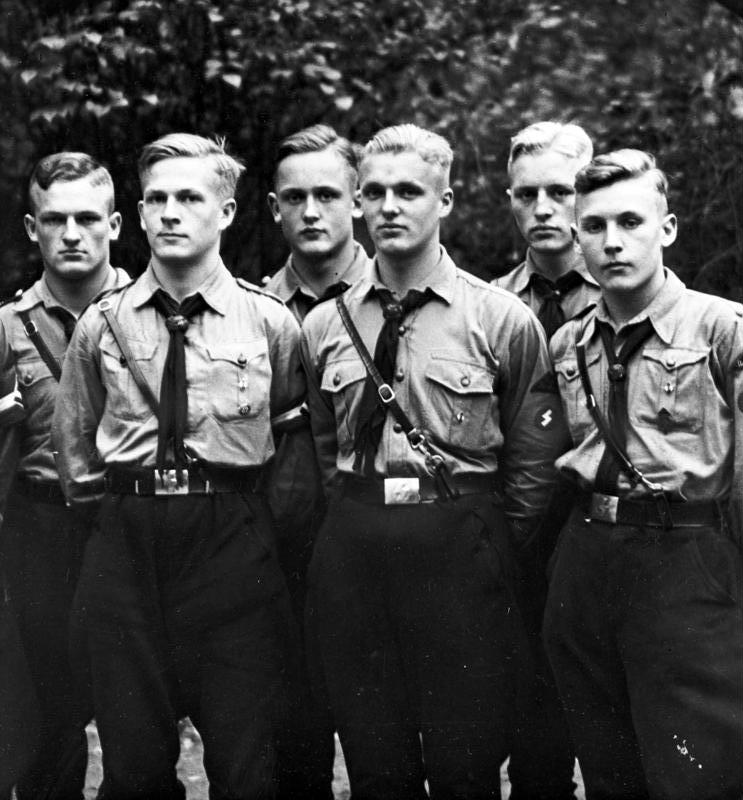
Exam Alert: Do not equate the three regimes’ youth policies without qualification. The Komsomol and Young Pioneers coexisted with genuine efforts to expand literacy and technical education (Soviet literacy rates rose dramatically in the 1930s). Nazi education was deliberately anti-intellectual in some respects (the emphasis on racial theory over rigorous science). Mussolini’s education system maintained more continuity with pre-Fascist curricula than either. Examiners reward these distinctions.
Treatment of Minorities
Nazi Germany — Racial Persecution:
Nazi racial ideology placed the persecution of minorities at the centre of state policy, not on the periphery. This distinguishes Nazism from the other two regimes.
- April 1933 boycott of Jewish businesses — the first public anti-Jewish action
- Nuremberg Laws (September 1935): stripped Jews of German citizenship; defined Jewishness by race (grandparents); prohibited marriage between Jews and non-Jews. Jews became stateless non-persons in their own country
- Kristallnacht (Night of Broken Glass, 9–10 November 1938): state-organised pogrom — 91 Jews killed (official figure), 7,500 Jewish businesses destroyed, 267 synagogues burned, 30,000 Jews arrested and sent to concentration camps. Presented as a “spontaneous” popular reaction
- From 1939, the Holocaust — systematic genocide — killing 6 million Jews and approximately 5–6 million others (Sinti/Roma, Slavic civilians, Soviet POWs, people with disabilities, gay men, Jehovah’s Witnesses)
Fascist Italy:
- Until 1938, Italian Fascism had no systematic racial policy. Italian Jews participated in the Fascist Party and the military. Some were prominent Fascists
- The Racial Laws of 1938 (modelled partly on Nuremberg Laws) stripped Italian Jews of citizenship, barred them from schools, professions, and mixed marriages. This was widely seen as Mussolini capitulating to Hitler
- Approximately 6,800 Italian Jews were deported and killed, mostly after the German occupation of northern Italy (1943–1945)
Stalinist USSR:
- The USSR’s relationship with minorities was complex. The early Bolshevik period had promoted national languages and cultures (korenizatsiya — “nativisation”)
- Under Stalin, the policy reversed: Russification — promotion of Russian language and culture; suppression of minority languages in schools
- Mass deportations of entire nationalities: Koreans (1937), Volga Germans (1941), Chechens, Ingush, Crimean Tatars (1944)
- Anti-Semitism was not official policy until Stalin’s last years; the 1952–1953 Doctors’ Plot was an anti-Semitic campaign against Jewish physicians at the highest levels, cut short by Stalin’s death
Key distinction on minorities:
Nazi racial persecution was ideologically central and escalated to genocide. Italian racial persecution was politically opportunistic (1938 only, under German pressure) and limited in scale. Soviet persecution of minorities was politically motivated (national security, Russification) rather than racial-biological, though no less deadly. This distinction matters enormously for evaluating the nature of each authoritarian state.
3.3 Was “Total Control” Achieved?
The question of whether these regimes achieved genuine totalitarian control is one of the most important historiographical debates for Paper 2.
Arguments for significant control:
- All three banned opposition parties, controlled press and media, created secret police, and eliminated organised dissent
- Public conformity was very high — it is almost impossible to find documented examples of open defiance in any of the three states after the mid-1930s
- Youth indoctrination shaped a generation that had never known political alternatives
Arguments against total control:
| Argument | Germany | Italy | USSR | China (Mao) | Cuba (Castro) |
|---|---|---|---|---|---|
| Private sphere survived | Germans maintained private religious practice; Catholic Church retained some autonomy | Church and monarchy remained independent institutions throughout | Private religious belief survived despite anti-religious campaigns | Traditional family loyalties survived; private markets persisted in villages | Catholic Church survived (suppressed but not eliminated); family networks maintained |
| Elite resistance | Wehrmacht officers’ July 1944 plot | Some conservative elites never became Fascists | Old Bolsheviks resisted until physical elimination | Deng Xiaoping twice purged but survived; “capitalist roaders” in CCP continued to exist | Some military figures uncomfortable with Soviet dependency; internal party debates on pace of change |
| Black markets | Black markets grew during the war | Economic black markets widespread | Tolkachi (supply fixers) essential to the planned economy | Large informal peasant markets re-emerged after Great Leap famine; Deng normalised them | Black market (bolsa negra) developed due to shortages; significant informal economy exists |
| Historiographical debate | Gestapo’s small size (Gellately: relied on denunciations) | Renzo De Felice: majority of Italians gave genuine consent, not just coerced | Sheila Fitzpatrick: ordinary Soviets had strategies of accommodation, not just passive terror | Frank Dikotter: argues Mao’s campaigns were more chaotic than planned; peasants found ways to deceive quotas | Antoni Kapcia: Castro’s regime maintained genuine popular legitimacy especially through healthcare/education gains |
Watch: Policies — Economy, Society, and Control
IB Tip: When asked “to what extent did [leader] achieve total control?”, do not simply say “yes completely” or “no, the people resisted.” The best answers argue that the degree of control varied across dimensions: economic control was more complete than cultural control; public conformity was achieved while private belief and minor evasion continued. Use specific historians (Gellately for Germany, De Felice for Italy, Fitzpatrick for USSR) to show examiners that you engage with the scholarly debate.
Section 4: Comparative Analysis
4.1 Similarities Between the Three Regimes
Despite ideological differences (especially between Stalin and the Fascists), the three regimes share significant structural features.
Similarities — OPTIC:
- One-party state: All three banned rival parties and created a political monopoly
- Personality cult: All three built cults of the leader as infallible, almost supernatural
- Terror apparatus: All three used secret police, arbitrary arrest, and camps to suppress opposition
- Ideological control: All three attempted to control education, media, and culture to shape belief
- Centrally planned or directed economy: All three expanded state control over economic life (to varying degrees)
Shared features in more detail:
| Feature | All Three |
|---|---|
| Single-party monopoly | Germany (NSDAP), Italy (PNF), USSR (CPSU) |
| Glorification of the state/nation | Germany (“the Volksgemeinschaft”), Italy (the Roman Empire reborn), USSR (“the socialist fatherland”) |
| Anti-liberalism | Rejection of parliamentary democracy, individual rights, and free markets |
| Expansionist foreign policy | Germany (Lebensraum), Italy (African empire + Balkans), USSR (Comintern; expansion into Eastern Europe 1939–1940) |
| Suppression of free trade unions | Germany (DAF), Italy (replaced with Fascist unions), USSR (unions became transmission belts for Party directives) |
4.2 Differences Between the Regimes
Key Differences — Ideology, Scale of Terror, Economic Approach:
| Dimension | Hitler’s Germany | Mussolini’s Italy | Stalin’s USSR | Mao’s China | Castro’s Cuba |
|---|---|---|---|---|---|
| Ideology | Racial nationalism; antisemitism as core | Ultra-nationalism; anti-Marxism; corporatism | Marxism-Leninism; class war; internationalism | Sinicised Marxism-Leninism; agrarian revolution; anti-imperialism; nationalism | Anti-imperialism; socialism; nationalism; initially flexible — adopts Marxism-Leninism after 1961 |
| Scale of internal repression | High — millions of Jews and others killed | Low by comparison — thousands sentenced | Extreme — millions executed or died in Gulag | Extreme — est. 40–80m excess deaths 1949–1976 (famine + campaigns); contested by historians | Moderate — thousands imprisoned, some executed; large emigration |
| Economic system | Mixed — retained private ownership with state direction; market mechanisms used | Corporate state rhetoric; private ownership retained; some state direction | Total collectivisation; state owned all means of production | Land reform (1949–52) then collectivisation; Great Leap Forward (1958–62) catastrophic failure; partial retreat | Nationalised industry and agriculture; rationing system; strong social spending on healthcare and education |
| Role of existing institutions | King, Church, army retained until replaced/co-opted | King, Church, army retained throughout (significant limits on Mussolini’s power) | All pre-existing institutions destroyed by 1917 revolution | Imperial/Republican institutions swept away; PLA as new institutional pillar | Batista institutions destroyed; new revolutionary institutions (CDRs, FMC) built from scratch |
| Treatment of religion | Targeted Christianity but never fully suppressed it | Concordat with Vatican (1929) — Church as ally | Militant atheism; churches closed; clergy persecuted | Anti-religion campaign; Cultural Revolution destroyed temples and churches; Buddhism/Taoism suppressed | Catholic Church suppressed but not eliminated; priests expelled or imprisoned 1960s; some normalisation later |
| Role of racial ideology | Central — the “master race” and extermination of “inferiors” | Marginal until 1938; then adopted under German pressure | Not racial — class-based ideology; but ethnic deportations occurred | Not racial — class-based; but ethnic minority policies often assimilationist or repressive (Tibet, Xinjiang) | Not racial — declared racial equality as a revolution goal; Afro-Cuban integration formal policy (though inequality persisted) |
4.3 Comparative Themes for Essay Practice
Theme 1: Was fascism or communism more “totalitarian”?
A common analytical framework is that Nazi Germany and Stalinist USSR achieved more complete control than Mussolini’s Italy. Evidence: Italy retained the monarchy and the Catholic Church as independent power centres; Mussolini could technically have been dismissed by the king (and was — in July 1943). Hitler and Stalin had no such constraint by the late 1930s.
Theme 2: The role of ideology vs. opportunism
- Hitler: Ideological goals (Lebensraum, racial state) were genuinely held and consistently pursued — intentionalist historians argue Mein Kampf was a blueprint
- Mussolini: Often described as fundamentally pragmatic — his ideology was “whatever works.” Denis Mack Smith argued Mussolini was an actor who came to believe his own performance
- Stalin: Combined genuine Marxist-Leninist beliefs with ruthless personal ambition. Robert Service and Simon Sebag Montefiore emphasise that Stalin genuinely believed he was building socialism while eliminating class enemies
Theme 3: The consent-coercion balance
- All three regimes were most stable when they had popular support, especially in their early years:
- Hitler: genuine popular approval was high in Germany 1933–1942 (economic recovery, foreign policy successes)
- Mussolini: De Felice argued real consensus in the 1930s (“years of consent”)
- Stalin: Popular enthusiasm for industrialisation and the “building of socialism” was genuine among many urban workers and Party members in the early 1930s
Section 5: Paper 2 Exam Technique
5.1 Understanding Paper 2 Format
Paper 2 tests your ability to write analytical historical essays under timed conditions. There are no sources — this is pure essay writing from memory.
Format:
- 90 minutes total
- Write TWO essays from the topics studied
- Each essay: 15 marks
- Recommended time: 5 minutes planning + 40 minutes writing per essay
Mark bands (simplified):
| Band | Marks | Description |
|---|---|---|
| 1 | 1–4 | Narrative/descriptive; little analysis; inaccurate or very limited knowledge |
| 2 | 5–8 | Some relevant knowledge; attempts analysis; lacks focus on the question |
| 3 | 9–11 | Mostly accurate knowledge; some consistent analysis; partial answer to the question |
| 4 | 12–14 | Accurate and relevant knowledge; consistent analysis; clear answer to the question with some support |
| 5 | 15 | Comprehensive knowledge; sustained analysis; well-structured argument; explicitly addresses all aspects of the question; may include historiography |
The difference between Band 3 and Band 5:
- Band 3 student: writes accurate facts about Hitler’s consolidation of power
- Band 5 student: uses accurate facts to build a sustained argument that answers the specific question, qualifies claims, considers counterarguments, and may reference historical debate
The knowledge is the same. The difference is argument structure and analytical consistency.
5.2 Command Terms
IB History Paper 2 uses specific command terms that tell you what kind of answer is expected. Ignoring the command term is one of the most common ways to lose marks.
| Command Term | What It Requires |
|---|---|
| Discuss | Present multiple perspectives on a topic; consider different aspects; come to a conclusion |
| To what extent | Partially agree/disagree; acknowledge the claim in the question has merit; present evidence for and against; reach a qualified conclusion |
| Compare and contrast | Explicitly identify similarities AND differences between two cases; do not simply describe each separately |
| Evaluate | Weigh the evidence; assess the relative importance of factors; reach a judgment |
| Examine | Investigate and consider carefully; analyse different aspects |
| Analyse | Break down into components; discuss causes, consequences, and interrelationships |
Exam Alert: “Discuss” does NOT mean “list everything you know.” It means construct an argument that considers multiple perspectives. “To what extent” requires a qualified answer — not simply “completely” or “not at all.” Students who write a one-sided answer to a “to what extent” question are capped at Band 3.
5.3 Essay Structure
A strong Paper 2 essay follows a clear structure:
Introduction (5–8 sentences):
- Contextualise the question briefly
- Define any key terms in the question
- State your argument (thesis) — your answer to the question
- Briefly indicate the main points you will develop
- If relevant, reference two case studies you will use
Body paragraphs (3–4 paragraphs): Each paragraph should:
- Open with a topic sentence that makes a clear analytical point linked to the question
- Provide evidence (specific facts, dates, events, statistics)
- Analyse — explain how the evidence supports your point
- Link back to the question and your thesis
Conclusion (5–6 sentences):
- Summarise your argument (do not introduce new evidence)
- Give a clear, direct answer to the question
- Qualify your conclusion where appropriate — acknowledge complexity
IB Tip: The single biggest mark-earner in Paper 2 is having a clear thesis in your introduction that you sustain throughout. Examiners read hundreds of essays that describe events accurately but never make an argument. State your position clearly: “While economic factors were significant, the structural weakness of Weimar democracy was the most important condition enabling Hitler’s rise to power because…“
5.4 “Different Regions” Requirement
Many Paper 2 questions require you to use two authoritarian states from different regions. The IB defines regions broadly:
- Europe: Germany, Italy
- Asia: Mao’s China, Ho Chi Minh’s Vietnam
- Americas: Castro’s Cuba, Perón’s Argentina
- Middle East/Africa: (less common case studies)
The USSR problem: Stalin’s USSR spans Europe and Asia geographically, but the IB treats it as its own category. Stalin and Hitler cannot be paired as “different regions” in most marking schemes — both are treated as European contexts. Check your exam question carefully.
Safe pairings for this guide’s case studies:
- Hitler (Europe) + Stalin (treated as distinct from Western Europe — generally acceptable)
- Mussolini (Europe) + Stalin (generally acceptable)
- Hitler or Mussolini paired with Mao Zedong, Castro, or Perón (clear different-region pairing)
Exam Alert: The “different regions” requirement is where students most commonly lose marks. Read the question twice before planning your essay. If the question says “with reference to two authoritarian leaders from different regions,” you cannot write about Hitler AND Mussolini — both are European. If you do, your essay will be heavily penalised regardless of quality.
Section 6: Practice Questions
6.1 Paper 2 Style Questions — Full List
The following questions are modelled directly on past and specimen IB History Paper 2 questions for Topic 10. Practice these under timed conditions (40 minutes each).
Emergence questions:
-
“Economic factors were the main reason for the emergence of authoritarian states.” Discuss with reference to two authoritarian states.
-
To what extent was the weakness of existing political systems responsible for the rise to power of authoritarian leaders? Refer to two authoritarian leaders in your answer.
-
Compare and contrast the methods used by two authoritarian leaders to seize power.
-
Evaluate the role of propaganda in the rise to power of two authoritarian leaders from different regions.
-
“Authoritarian leaders exploited fear more than they offered genuine solutions.” Discuss with reference to two authoritarian states.
Consolidation questions:
-
Examine the methods used by one authoritarian leader to consolidate his power after coming to office.
-
“Terror was the most important method used by authoritarian leaders to maintain power.” To what extent do you agree? Refer to two authoritarian states.
-
Compare and contrast the use of propaganda by two authoritarian leaders to maintain power.
-
To what extent did legal methods play a role in consolidating the power of one authoritarian leader?
-
Evaluate the significance of the Night of the Long Knives (1934) in Hitler’s consolidation of power.
Policy questions:
-
“Authoritarian leaders’ economic policies benefited their states.” To what extent do you agree? Refer to two authoritarian states.
-
Compare and contrast the social policies of two authoritarian leaders with regard to the treatment of women.
-
To what extent did Stalin achieve total control of the USSR by 1941?
-
Examine the impact of Fascist economic policies on Italy in the period 1922–1940.
-
“The social policies of authoritarian states were primarily designed to serve military and economic aims.” Discuss with reference to two authoritarian states.
Comparison questions:
-
Compare and contrast the use of terror in two authoritarian states.
-
To what extent were the methods used by Hitler and Mussolini to consolidate power similar?
-
Evaluate the role of ideology in the policies of two authoritarian leaders.
-
“Authoritarian states achieved political but not social control.” Discuss.
-
Compare and contrast the treatment of minorities in two authoritarian states in the 20th century.
6.2 Model Answer Outlines
Question 1: “Economic factors were the main reason for the emergence of authoritarian states.” Discuss with reference to two authoritarian states.
Command term: Discuss — argue multiple perspectives; reach a conclusion
Thesis (intro): Economic factors were a necessary but not sufficient condition for the emergence of authoritarian states. While the Great Depression and post-war economic dislocation created mass grievances that authoritarian movements exploited, structural political weaknesses and effective leadership in channelling resentment were equally important in determining whether authoritarian movements actually captured the state.
Case studies: Hitler’s Germany and Mussolini’s Italy
Paragraph 1 — Economic factors supporting the claim:
- Germany: Unemployment rose to 6.1 million by January 1933. Nazi vote share correlated directly with unemployment: 2.6% (1928, pre-Depression) → 18.3% (1930) → 37.4% (July 1932)
- Italy: Post-war economic dislocation; Biennio Rosso (1919–1920) — factory occupations and rural strikes terrified the middle class and industrialists, who financed the Fascist squads
- In both cases, the economic crisis delegitimised existing governments (Weimar coalitions’ inability to respond; liberal Italy’s trasformismo)
- Point: economic crisis created mass anxiety that authoritarian movements could channel
Paragraph 2 — Limitations of purely economic explanation:
- Germany had worse economic conditions in 1923 (hyperinflation) but Hitler’s Beer Hall Putsch failed completely
- The Depression also devastated Britain and France — democratic countries where fascism did not win power. Therefore economic crisis alone cannot explain authoritarian emergence
- Italy’s economic crisis (Biennio Rosso) had largely subsided by October 1922 when the March on Rome occurred — yet Mussolini still took power. Political factors (the king’s decision not to use martial law) were decisive
- Point: the same economic conditions produced different political outcomes, suggesting political and institutional factors were independent variables
Paragraph 3 — Political/institutional factors:
- Weimar Republic’s structural flaws: proportional representation, Article 48, presidential power, weak coalitions — these created a system that could not respond decisively to the Depression
- Italy: Liberal Italy’s trasformismo had produced chronic governmental instability for decades before the Depression; the political system was already delegitimised independently of economics
- Without the conservative elite’s miscalculation (inviting Hitler into a coalition; Victor Emmanuel III refusing martial law), neither leader would have taken power regardless of the economic context
- Point: political weakness was a precondition that economic crisis activated
Paragraph 4 — Role of leadership and ideology:
- Hitler’s organisational genius and propaganda abilities (Goebbels), and the Nazi Party’s cross-class appeal, distinguished German fascism from other right-wing movements that failed in the same economic conditions
- Mussolini’s ability to position himself as the protector of order (against the socialist threat) while remaining flexible on ideology was a leadership quality, not an economic variable
- Point: the ability to exploit conditions depended on the specific character of the authoritarian movement itself
Conclusion:
Economic factors were the primary trigger for mass support of authoritarian movements — without the Depression, it is very unlikely that either Hitler or Mussolini would have won sufficient support to challenge for power. However, the conversion of that support into state power depended on political factors: institutional weaknesses in existing systems and the calculated errors of conservative elites. A complete explanation requires all three dimensions: economic crisis, political weakness, and effective leadership. To argue economic factors were “the main reason” is to explain mass support but not to explain the specific political mechanisms by which the state was captured.
Examiner’s note: This answer would score in Band 4–5. It addresses the command term (“discuss” = multiple perspectives), uses specific evidence (unemployment figures, dates, electoral percentages), maintains analytical focus on the question throughout, and reaches a nuanced conclusion that qualifies the claim without simply agreeing or disagreeing.
Question 7: “Terror was the most important method used by authoritarian leaders to maintain power.” To what extent do you agree? Refer to two authoritarian states.
Command term: To what extent — partially agree; weigh evidence for and against; qualified conclusion
Thesis (intro): Terror was an essential component of all three authoritarian regimes’ maintenance of power, but its relative importance varied significantly. In Stalin’s USSR, terror was arguably the dominant method, eliminating all potential rivals and creating a society of mutual surveillance. In Mussolini’s Italy, however, consent — built through propaganda, the Lateran Treaties, and genuine popular approval in the 1930s — was at least as important as coercion. A complete account of how these regimes maintained power must recognise that terror and consent operated simultaneously and reinforced each other.
Case studies: Stalin’s USSR and Mussolini’s Italy (different regions if treating USSR as non-Western European)
Paragraph 1 — Terror as the primary mechanism (USSR):
- The Great Purge (1936–1938): approximately 750,000–800,000 shot in 1937–1938; all potential rivals within the Party eliminated
- The Gulag system: 18 million passed through; created a population who knew the consequences of non-compliance
- The military purge: 35,000–40,000 officers removed, including 3 of 5 Marshals — eliminated any military threat
- NKVD surveillance and denunciation system: created a climate of fear that extended into private life
- Assessment: In the USSR, terror was so pervasive that it is difficult to argue any other mechanism was more important to Stalin’s maintenance of power
Paragraph 2 — Limits of terror as primary explanation (Italy):
- The OVRA had only approximately 1,000 full-time agents; the Special Tribunal sentenced fewer than 5,000 people across its entire existence
- De Felice’s “years of consent” thesis: many historians argue that Mussolini enjoyed genuine popular support in the 1930s — economic improvements, the conquest of Abyssinia (1935–1936), the Lateran Treaties (1929)
- The Catholic Church — encompassing 99% of Italians — actively endorsed the regime after 1929
- Comparison: the limited scale of Italian terror suggests that consent mechanisms were equally or more important in Italy than coercion
- Point: Terror alone did not maintain Fascist Italy
Paragraph 3 — The combination of terror and consent:
- Even in the USSR, Sheila Fitzpatrick argues that ordinary Soviets developed strategies of accommodation and even genuine enthusiasm for Soviet projects (literacy campaigns, industrialisation, anti-fascism)
- In Germany, Ian Kershaw’s “Hitler Myth” shows that terror worked alongside genuine popular approval of Hitler (high approval 1933–1942) — when approval declined during the war, the regime relied more heavily on terror
- Terror was most important as a mechanism against organised opposition (political parties, military officers); consent mechanisms were more important for managing the passive majority
- Point: the relationship between terror and consent was dynamic, not static
Conclusion:
Terror was the most important method in Stalin’s USSR, where it reached a scale that eliminated all plausible internal threats to the regime. In Mussolini’s Italy, by contrast, the limited scale of repression suggests that propagandistic consent — particularly through the Church alliance and genuine economic improvements — was at least equally important. The question as posed is therefore partially valid: it accurately describes the USSR but overstates the case for Italy. The most accurate generalisation is that authoritarian regimes maintained power through a combination of terror and consent, with the balance varying significantly between regimes and over time.
Question 3: Compare and contrast the methods used by two authoritarian leaders to seize power.
Command term: Compare and contrast — find both similarities AND differences; structure around themes, not separate descriptions
Thesis (intro): Hitler and Mussolini both employed a combination of street violence, elite alliances, and propaganda to seize power, and both were ultimately elevated to office by conservative elites who miscalculated their ability to control them. However, they differed significantly in the institutional mechanisms through which they captured state power: Hitler relied primarily on the electoral legitimacy generated by the Nazi Party’s mass mobilisation, while Mussolini relied on direct paramilitary intimidation through the squadrismo, which bypassed the electoral arena entirely.
Similarities:
- Street violence as political tool: Both used paramilitary organisations (SA/SS in Germany; squadre in Italy) to intimidate, beat, and murder political opponents — primarily socialists and communists. The violence served both to suppress the left and to demonstrate strength to conservative supporters
- Elite sponsorship: Both were funded and politically supported by industrialists and landowners who feared socialist revolution. Both were appointed to power by existing constitutional authorities (Hindenburg; Victor Emmanuel III) rather than seizing it by armed force against the state
- Propaganda: Both used mass media, theatrical public events, and emotional nationalist rhetoric to build popular movements. Both positioned themselves as saviours from communism and national humiliation
- Legal pathway used alongside violence: Neither came to power purely through violence — both maintained a legal face. Hitler ran in elections; Mussolini negotiated with Giolitti and ran a parliamentary party alongside the squads
Differences:
- Electoral vs. paramilitary emphasis: Hitler built a genuine mass electoral movement — the Nazi Party won 37.4% in July 1932, the largest vote in Weimar history. Mussolini’s Fascists never won a free election with comparable support; the March on Rome was a paramilitary threat, not an electoral mandate
- Timing of violence: The squadrismo violence was most intense before Mussolini took power (1920–1922) and was used to destroy the left’s organisational base before the final political move. SA violence was primarily used during the electoral campaign period (1930–1933) to intimidate opponents rather than to destroy infrastructure
- The role of existing institutions: In Italy, the March on Rome was a direct paramilitary challenge to the state that the state chose not to resist. In Germany, the transfer of power was entirely legal — Hindenburg appointed Hitler through the constitutional mechanism available to the president. The subsequent destruction of democracy was achieved through the Reichstag Fire Decree and the Enabling Act — legal instruments, even if the process was coerced
- Speed of power consolidation: Hitler moved with extraordinary speed — he effectively ended German democracy within six months of taking office. Mussolini took three years from becoming Prime Minister (October 1922) to establishing full dictatorship (January 1925)
Conclusion:
Hitler and Mussolini present two versions of authoritarian seizure of power that share structural features — violence, elite support, propaganda, nationalist ideology — but differ fundamentally in their relationship to democratic legitimacy. Hitler used elections as a tool, converting mass votes into appointment to office. Mussolini bypassed elections with a paramilitary threat and relied on the monarchy’s refusal to resist. Both paths led to the same destination, but through different institutional mechanisms. This comparison illustrates that there is no single “authoritarian playbook” — the specific path to power was shaped by each country’s institutional context.
Question 11: “Authoritarian leaders’ economic policies benefited their states.” To what extent do you agree? Refer to two authoritarian states.
Command term: To what extent — weigh evidence; qualified conclusion
Thesis: Economic policies under authoritarian states produced genuine short-term improvements in some indicators — notably in reducing unemployment and industrialising backward economies — but these gains were achieved at enormous human cost, created structural economic distortions, and were ultimately oriented toward military rather than civilian welfare. The extent of “benefit” depended heavily on who was included in the calculation and over what time period.
Case studies: Hitler’s Germany and Stalin’s USSR
Evidence for benefit — Germany:
- Unemployment: 6.1 million (1933) → 1.6 million (1936) → near-full employment (1938)
- Autobahn construction, public housing, rearmament drove economic recovery
- Real wages for employed workers rose modestly through 1938
- The German economy grew at approximately 8% per year 1933–1938
Evidence against benefit — Germany:
- The recovery was built on deficit spending (Mefo bills) — sustainable only if war produced conquest and plunder
- Rearmament meant consumers were squeezed — butter vs. guns (Goering: “guns make us powerful; butter only makes us fat”)
- Jewish Germans, Roma, and other excluded groups experienced confiscation of property, loss of livelihoods, and ultimately death — the “economic recovery” excluded approximately 1% of the population by design
- Germany faced a fiscal crisis by 1939 that made war economically attractive
Evidence for benefit — USSR:
- Steel production tripled; coal production quintupled 1928–1940
- Industrial base made Soviet victory over Nazi Germany possible 1941–1945
- Literacy rates rose dramatically; education and healthcare expanded
- Life expectancy rose from 32 (1913) to 47 (1939)
Evidence against benefit — USSR:
- Collectivisation killed approximately 5–8 million people
- Consumer goods were severely neglected; living standards for ordinary workers fell during industrialisation
- The Gulag provided forced labour as an input to industrialisation — benefits were built on slave labour
- The grain export policy during the 1932–1933 famine — exporting grain while millions starved — is not compatible with any definition of “benefit”
Conclusion:
Economic policies produced measurable benefits by narrow indicators (employment, industrial output) but these gains were achieved through methods — forced labour, genocide, starvation — that make any simple claim of “benefit” morally and empirically untenable. The more accurate assessment is that economic policies served the state and military apparatus effectively while often degrading the lives of the very populations they claimed to serve. Hitler’s economic recovery benefited employed ethnic Germans in the short term but was a preparation for war, not a foundation for sustainable prosperity. Stalin’s industrialisation created a heavy industrial base at a cost measured in millions of lives.
Section 7: Key Timelines
Master Chronology — All Three States
Germany:
| Date | Event |
|---|---|
| 28 Jun 1919 | Treaty of Versailles signed |
| Nov 1923 | Beer Hall Putsch fails; Hitler arrested |
| Jul 1925 | Mein Kampf published (Volume 1) |
| Sep 1929 | Great Depression begins |
| Sep 1930 | NSDAP wins 18.3% — second-largest party |
| Jul 1932 | NSDAP wins 37.4% — largest party ever |
| 30 Jan 1933 | Hitler appointed Chancellor by Hindenburg |
| 27 Feb 1933 | Reichstag Fire |
| 28 Feb 1933 | Reichstag Fire Decree — civil liberties suspended |
| 5 Mar 1933 | Election: NSDAP wins 43.9% |
| 23 Mar 1933 | Enabling Act passed — Hitler rules by decree |
| Apr–Jul 1933 | Gleichschaltung: states, unions, parties eliminated |
| 14 Jul 1933 | Law against new parties — one-party state |
| 30 Jun 1934 | Night of the Long Knives |
| 2 Aug 1934 | Death of Hindenburg; Hitler becomes Führer |
| Sep 1935 | Nuremberg Laws — Jews stripped of citizenship |
| 9–10 Nov 1938 | Kristallnacht |
| 1 Sep 1939 | Invasion of Poland — WWII begins |
| 1941–1945 | Holocaust — 6 million Jews murdered |
| 20 Jul 1944 | July Plot — bomb under Hitler’s table; survives |
| 30 Apr 1945 | Hitler’s suicide in Berlin |
Italy:
| Date | Event |
|---|---|
| 1919–1920 | Biennio Rosso — Red Years; Fascist squads form |
| Mar 1919 | Mussolini founds fasci di combattimento in Milan |
| Oct 1922 | March on Rome |
| 29 Oct 1922 | Mussolini appointed Prime Minister |
| Jul 1923 | Acerbo Law — electoral reform guarantees Fascist majority |
| Apr 1924 | Elections — Fascists win 66.3% with violence and fraud |
| Jun 1924 | Matteotti kidnapped and murdered |
| Jun–Dec 1924 | Aventine Secession — opposition withdraws from parliament |
| 3 Jan 1925 | Mussolini’s dictatorial speech — Fascist dictatorship begins |
| 1925–1926 | Leggi Fascistissime — opposition banned; press censored |
| 1927 | OVRA secret police established |
| Feb 1929 | Lateran Treaties — Vatican recognised |
| 1935–1936 | Conquest of Abyssinia |
| 1936 | Rome-Berlin Axis with Hitler |
| 1938 | Racial Laws — Jews stripped of rights |
| 1940 | Italy enters WWII on German side |
| Jul 1943 | Allied invasion; Fascist Grand Council votes against Mussolini; king dismisses him |
| Apr 1945 | Mussolini captured and shot by partisans |
USSR (Stalin):
| Date | Event |
|---|---|
| Oct 1917 | Bolshevik Revolution |
| 1918–1921 | Civil War; Red Terror |
| 1921 | New Economic Policy (NEP) introduced |
| 21 Jan 1924 | Lenin dies |
| 1924–1929 | Stalin eliminates Trotsky, Zinoviev, Kamenev, Bukharin |
| 1929 | Stalin supreme — “Year of the Great Turn” |
| 1929–1933 | Collectivisation; dekulakisation |
| 1932–1933 | Ukrainian Famine (Holodomor) — up to 7 million dead |
| 1928–1932 | First Five Year Plan |
| 1933–1937 | Second Five Year Plan |
| Aug 1936 | Trial of the Sixteen — Zinoviev and Kamenev executed |
| 1937 | Military purge — Red Army officer corps decimated |
| Jan 1937 | Trial of the Seventeen |
| Mar 1938 | Trial of the Twenty-One — Bukharin executed |
| 1936 | ”Stalin Constitution” proclaimed |
| Aug 1939 | Molotov-Ribbentrop Pact with Nazi Germany |
| Sep 1939 | USSR invades eastern Poland |
| Jun 1941 | Operation Barbarossa — Germany invades USSR |
| 1941–1945 | Great Patriotic War; USSR suffers 27 million dead |
| 5 Mar 1953 | Stalin dies |
Section 8: Key Figures Reference
Key Figures — Germany:
| Name | Role | Significance |
|---|---|---|
| Adolf Hitler | Führer | Founded NSDAP; Chancellor Jan 1933; Führer Aug 1934 |
| Paul von Hindenburg | President (died Aug 1934) | Appointed Hitler Chancellor; his death enabled Hitler to merge presidencies |
| Joseph Goebbels | Reich Minister for Propaganda | Masterminded Nazi propaganda; controlled all media |
| Heinrich Himmler | SS chief; later Interior Minister | Controlled SS, Gestapo, concentration camp system |
| Ernst Röhm | SA chief (killed Jun 1934) | Led the SA; his demands for “second revolution” led to his murder in Night of Long Knives |
| Hermann Göring | Aviation Minister; Four Year Plan | Led Luftwaffe; administered Four Year Plan economic expansion |
| Franz von Papen | Vice-Chancellor Jan 1933 | Conservative who persuaded Hindenburg to appoint Hitler, believing he could control him |
| Albert Speer | Armaments Minister from 1942 | Organised war economy; later testified at Nuremberg |
| Hans and Sophie Scholl | White Rose resisters | Distributed anti-Nazi leaflets at Munich University 1942–1943; executed |
Key Figures — Italy:
| Name | Role | Significance |
|---|---|---|
| Benito Mussolini | Duce (“Leader”) | Founded Fascist movement 1919; PM Oct 1922; dictator Jan 1925 |
| King Victor Emmanuel III | King of Italy 1900–1946 | Refused to declare martial law Oct 1922; dismissed Mussolini Jul 1943 |
| Giacomo Matteotti | Socialist MP | Gave speech denouncing electoral fraud; murdered Jun 1924 — the defining crisis of Mussolini’s rise |
| Antonio Gramsci | Communist leader | Arrested 1926; wrote Prison Notebooks in captivity; died 1937 |
| Italo Balbo | Fascist general; air minister | One of the quadrumvirs of the March on Rome; potentially a rival to Mussolini |
| Giovanni Gentile | Education Minister 1923 | Reformed Italian education along Fascist-idealist lines |
| Pietro Badoglio | Marshal; PM after Jul 1943 | Arrested Mussolini; negotiated armistice with Allies |
Key Figures — USSR:
| Name | Role | Significance |
|---|---|---|
| Joseph Stalin | General Secretary; Premier | Consolidated power 1924–1929; absolute rule 1929–1953 |
| Vladimir Lenin | Bolshevik founder; first Soviet leader | Established Soviet state; his Testament warned against Stalin |
| Leon Trotsky | Commissar for War; first rival | Led Red Army in Civil War; defeated by Stalin in succession struggle; exiled 1929; assassinated 1940 |
| Nikolai Bukharin | Editor Pravda; “Right Deviation” | Supported NEP; ally then target of Stalin; executed 1938 |
| Grigory Zinoviev & Lev Kamenev | Politburo members | Allied with Stalin against Trotsky, then defeated by Stalin; executed 1936 |
| Nikolai Yezhov | NKVD chief 1936–1938 | Oversaw the Great Purge (Yezhovshchina); later executed by Stalin |
| Vyacheslav Molotov | Foreign Minister 1939–1949 | Signed Molotov-Ribbentrop Pact (1939); loyal Stalinist |
| Sergei Kirov | Leningrad Party boss; murdered 1934 | His assassination (possibly ordered by Stalin) triggered the Great Purge |
Section 9: Common Exam Mistakes Checklist
Check your essays against this list before handing in:
-
Writing that Hitler was “democratically elected” — He was appointed Chancellor by Hindenburg, not elected. The Nazis never won a free election majority (best result: 37.4%).
-
Treating the March on Rome as the establishment of Mussolini’s dictatorship — It was the start of a coalition government. The dictatorship began with the January 1925 speech and the Leggi Fascistissime (1925–1926).
-
Pairing Hitler and Mussolini as “different regions” — Both are European. You will be penalised for ignoring the “different regions” requirement.
-
Describing all three regimes as equally terroristic — Italian Fascism was significantly less violent in terms of internal repression than Nazi Germany or Stalinist USSR. The OVRA sentenced fewer than 5,000 people; the Gulag held millions.
-
Confusing “Lebensraum” with Italian policy — “Lebensraum” (living space) is specifically Nazi. Use “spazio vitale” (vital space) or “empire” for Italy; use “socialist industrialisation” or “collectivisation” for Stalin.
-
Saying Stalin “invented” Soviet communism — The Bolshevik state was founded by Lenin. Stalin inherited an established one-party state and extended it; he did not create the framework from scratch.
-
Ignoring the role of conservative elites in Hitler and Mussolini’s rise — Both were appointed by existing constitutional authorities (Hindenburg; Victor Emmanuel III). The conservative elites’ miscalculation was decisive.
-
Treating the Great Purge as purely about eliminating enemies — It also served to terrorise the entire Soviet population into conformity, create scapegoats for economic failures, and break up any networks that could challenge Stalin.
-
Writing a “to what extent” essay that only argues one side — These questions require you to acknowledge the validity of the question’s claim and then qualify it. One-sided answers are capped at Band 3.
-
Confusing the Reichstag Fire Decree with the Enabling Act — The Fire Decree (February 1933) suspended civil liberties. The Enabling Act (March 1933) gave Hitler the power to pass laws without parliament. Both were essential steps, but they were separate and served different functions.
-
Saying Mussolini’s racial laws were a long-standing Fascist policy — The 1938 Racial Laws came 16 years into the regime and were widely seen as adopted under German pressure. Pre-1938, Italian Fascism had no systematic racial ideology and Jews participated openly in the party.
-
Stating that collectivisation was primarily about feeding Soviet workers — Collectivisation was primarily designed to extract grain surpluses for export (to finance industrial imports) and to break peasant resistance to state control. The food security of the peasantry was secondary.
Section 10: Essay Planning Workshop
10.1 How to Plan Under Timed Conditions
Five minutes of planning before writing saves ten minutes of wandering and produces a Band 5 essay instead of a Band 3 one. Here is a systematic method.
Step 1 — Decode the question (30 seconds):
- Identify the command term (discuss / to what extent / compare and contrast / evaluate)
- Identify the topic focus (emergence / consolidation / economic policy / social policy / foreign policy)
- Identify any constraints (two leaders / different regions / specific time period)
Step 2 — Choose your case studies (30 seconds):
- If “different regions” is required: pick one European (Hitler or Mussolini) and one non-European (Stalin counts as acceptable contrast in most marking schemes, or use Mao/Castro from your other paper 2 topic)
- If no region constraint: choose the two you know best for the specific topic
Step 3 — Draft your thesis in one sentence (1 minute): Do not begin “In this essay I will discuss…” — begin with your argument. Example: “While economic crisis was the necessary condition for both Hitler and Mussolini’s rise to power, the decisive factor was the miscalculation of conservative elites who invited both men into office believing they could be controlled.”
Step 4 — Plan 3–4 paragraph topic sentences (2 minutes): Each topic sentence should make a different analytical point. Do not plan by leader (Hitler paragraph, then Mussolini paragraph) — plan by theme (economic crisis, political weakness, elite miscalculation, leadership/propaganda). This creates comparison automatically.
Step 5 — Note 2–3 specific facts per paragraph (1 minute): Dates, names, statistics. You do not need full sentences — just anchors to prevent vagueness.
10.2 Paragraph Templates
A strong analytical paragraph for Paper 2 follows this structure. Practise until it is automatic.
Template — TEEL:
- Topic sentence: the analytical point
- Evidence: specific facts (dates, names, statistics)
- Explanation: how the evidence proves the point
- Link: back to the essay question
Example paragraph on propaganda:
“Propaganda was a crucial tool in both Hitler’s and Mussolini’s maintenance of power, though the mechanisms differed significantly. In Germany, Goebbels’ Reich Ministry of Public Enlightenment and Propaganda (established March 1933) coordinated all media — by 1939, 70% of German households owned a Volksempfänger radio, bringing Hitler’s speeches directly into German homes, and Leni Riefenstahl’s Triumph of the Will (1935) presented Nazi power as a quasi-religious spectacle. In Italy, the Luce Institute controlled cinema newsreels and the phrase ‘Mussolini ha sempre ragione’ was stencilled on walls nationwide. However, Italian propaganda was less comprehensive than Germany’s: the Catholic Church, which fell outside state control after the 1929 Lateran Treaties, continued to provide an alternative cultural narrative. This suggests that while propaganda was essential to both regimes, Germany achieved a more complete monopoly on the production of meaning, whereas Mussolini’s regime had to accommodate independent cultural institutions. This comparison illustrates that the degree of ‘total’ propagandistic control is better understood as a spectrum than a binary.”
IB Tip: Notice that the model paragraph above directly compares Germany and Italy within a single paragraph rather than writing about them separately. This integrated comparative structure is what examiners mean when they award marks for “sustained comparative analysis.” Writing two separate narrative blocks — first Germany, then Italy — is a Band 3 approach. Weaving comparison into each paragraph is a Band 5 approach.
10.3 Common Question Patterns and Strategic Responses
Pattern 1: “X was the most important factor…” — agree/disagree question
Strategy: Partially agree. Acknowledge the claim has merit with evidence. Then introduce a second factor that was equally or more important. Conclude with a qualified judgment that addresses the “most important” framing.
Trap: Do not simply disagree entirely — the question has been set because the claim has validity. Examiners want to see you acknowledge complexity.
Pattern 2: “Compare and contrast…”
Strategy: Plan thematically, not by leader. Paragraph 1: Similarities in X. Paragraph 2: Differences in X. Paragraph 3: Similarities in Y. Paragraph 4: Differences in Y. Always use linking phrases: “Similarly…”, “By contrast…”, “Unlike Hitler, Mussolini…”, “Both leaders…”
Trap: Writing a description of Hitler, then a description of Mussolini, with no explicit comparison. This gets Band 2.
Pattern 3: “To what extent did [leader] achieve [goal]?”
Strategy: Argue partial achievement. Use evidence of success, then evidence of limitations. Structure by dimension (political control achieved; economic control partially achieved; cultural control limited by Church/private sphere).
Trap: Arguing complete success or complete failure. Real historical situations are always more complex.
Pattern 4: “Discuss the role of [propaganda / terror / ideology] in…”
Strategy: Define the concept briefly. Argue its importance. Then argue its limits or what complemented it. Reach a judgment about relative importance.
Trap: Treating “discuss” as “describe.” Every paragraph needs to make an analytical claim, not just recount events.
Section 11: Historiography — Key Historians and Debates
Knowing the major historians and their arguments is the difference between a Band 4 and a Band 5 essay. You do not need to write long passages about historiography — one sentence placing a named historian’s view into your argument is sufficient and will demonstrate the analytical sophistication that examiners reward.
11.1 Hitler and Nazi Germany
On Hitler’s intentions and the origins of WWII:
- Hugh Trevor-Roper (The Last Days of Hitler, 1947; Hitler’s War Aims): An intentionalist. Hitler had a coherent long-term programme (race, Lebensraum, destruction of Soviet communism) evident from Mein Kampf (1925) onwards. WWII was Hitler’s planned war.
- A.J.P. Taylor (The Origins of the Second World War, 1961): A structuralist. Hitler was an opportunist who exploited circumstances; he had no timetable or blueprint for a specific war. Responsibility for WWII was shared by Western powers’ appeasement. Highly controversial — largely rejected today, but valuable to mention as a dissenting view.
- Ian Kershaw (Hitler, 1998–2000; The Hitler Myth, 1987): Synthesis. Hitler had ideological goals (especially Lebensraum and racial policy) but was also an opportunist. Distinguishes between Hitler’s charismatic authority and the “working towards the Führer” dynamic — subordinates competed to anticipate Hitler’s wishes, driving radicalisation without explicit orders.
On popular support and coercion:
- Robert Gellately (Backing Hitler, 2001): The Gestapo was small (c.7,000 agents) and functioned primarily through public denunciations — ordinary Germans informed on each other. Most Germans knew about concentration camps and anti-Jewish persecution. The regime had significant popular support.
- Robert Gellately vs. Daniel Goldhagen (Hitler’s Willing Executioners, 1996): Goldhagen argued that antisemitism was so deeply embedded in German culture (“eliminationist antisemitism”) that ordinary Germans enthusiastically participated in the Holocaust. Most historians view this as too deterministic; Browning’s Ordinary Men (1992) shows perpetrators were not ideologically fanatical — peer pressure, group dynamics, and incremental escalation explain much of the killing.
On the Holocaust:
- Intentionalists (Lucy Dawidowicz): Hitler planned the Holocaust from early in his political career; it was the central goal of National Socialism.
- Functionalists (Martin Broszat, Hans Mommsen): The Holocaust evolved through a cumulative process of radicalization driven by bureaucratic competition, not a master plan; the decision for genocide emerged from the chaos of war, not premeditated intention.
- Synthesis (Christopher Browning, Peter Longerich): Hitler had radical antisemitic goals, but the specific policy of systematic genocide crystallised in 1941–1942 in response to the evolving situation of the Eastern war.
IB Tip: You do not need to resolve the intentionalist-functionalist debate in your essay. Acknowledging that it exists — “historians debate whether the Holocaust was planned from the start (Dawidowicz) or evolved incrementally (Broszat)” — and showing how it affects our assessment of Hitler’s control over events is worth marks. Use historiography to complicate your argument, not as a substitute for one.
11.2 Mussolini and Italian Fascism
- Renzo De Felice (Mussolini, 8 volumes, 1965–1997): The dominant Italian-language biographer. Argued that Mussolini’s regime had a “middle period of consensus” (1929–1936) in which a genuine majority of Italians supported Fascism — not simply a product of coercion. De Felice’s work was controversial in Italy as it seemed to rehabilitate Fascism; his critics argued he minimised repression.
- Denis Mack Smith (Mussolini, 1981): British biographer; critical of De Felice. Mack Smith portrayed Mussolini as fundamentally an actor and opportunist, “a journalist who became a dictator,” more concerned with his personal image than with coherent ideology or statecraft. His foreign policy was often impulsive and poorly planned.
- Adrian Lyttelton (The Seizure of Power, 1973): Emphasises the role of the squadrismo and agrarian violence in building Fascism — the movement from below was as important as Mussolini’s political manoeuvres.
- Martin Clark (Mussolini, 2005): Balanced assessment; Mussolini as genuinely popular but also genuinely dependent on existing institutions (monarchy, Church, military) that set limits on his power.
11.3 Stalin and the Soviet Union
- Robert Conquest (The Great Terror, 1968; Harvest of Sorrow, 1986): The foundational Western account of the purges and collectivisation. Conquest argued these were deliberate genocidal policies, not simply “excesses” of industrialisation. The Holodomor, he argued, was an intentional famine.
- Sheila Fitzpatrick (Everyday Stalinism, 1999; Stalin’s Peasants, 1994): Social historian; argues that ordinary Soviet citizens were not simply victims but active participants in the Stalinist system — denouncing neighbours, pursuing social mobility through the Party, accommodating the regime in complex ways. Challenges the totalitarian model’s assumption of complete top-down control.
- Robert Service (Stalin: A Biography, 2004): Comprehensive biography emphasising Stalin’s genuine ideological commitment. Stalin genuinely believed he was building socialism and eliminating class enemies — he was not simply a cynical power-seeker.
- Simon Sebag Montefiore (Stalin: The Court of the Red Tsar, 2003): Uses newly opened Soviet archives to portray Stalin’s inner circle as a paranoid court where personal relationships, fear, and mutual suspicion drove policy. Humanises (without excusing) the purges as products of a specific political culture.
- Oleg Khlevniuk (Stalin: New Biography of a Dictator, 2015): Russian historian with full archive access. Most authoritative current account. Argues Stalin was the direct driving force behind the terror, not a passive approver of subordinates’ initiatives.
On the totalitarianism concept:
- Hannah Arendt (The Origins of Totalitarianism, 1951): The foundational theoretical work arguing that Nazism and Stalinism were structurally similar “totalitarian” systems distinguished by their use of terror, ideology, and the elimination of the private sphere. Still highly influential.
- Carl Friedrich and Zbigniew Brzezinski (Totalitarian Dictatorship and Autocracy, 1956): Produced a six-point model of totalitarianism (ideology, single party, terror, monopoly of communications, weapons, and economy) — useful for structuring comparative analysis.
- Critics of the totalitarianism concept: Some historians argue the term collapses important differences between Nazi racial genocide and Soviet class-based terror, and overestimates the actual control achieved by any state.
Quick historian reference — Paper 2 drop-ins:
| Historian | Work | Key argument |
|---|---|---|
| Ian Kershaw | Hitler (1998–2000) | Hitler as charismatic authority; “working towards the Führer” |
| Robert Gellately | Backing Hitler (2001) | Ordinary Germans knew about and often supported Nazi persecution |
| Renzo De Felice | Mussolini (multi-volume) | Genuine popular consensus in Italy 1929–1936 |
| Denis Mack Smith | Mussolini (1981) | Mussolini as actor/opportunist; poor statesman |
| Sheila Fitzpatrick | Everyday Stalinism (1999) | Soviets as active participants, not just victims |
| Robert Service | Stalin (2004) | Stalin as genuine ideological believer |
| Robert Conquest | The Great Terror (1968) | Systematic genocidal intent behind purges and collectivisation |
| Hannah Arendt | Origins of Totalitarianism (1951) | Nazism and Stalinism as structurally similar “totalitarian” systems |
Section 12: Extended Concept Review — Key Terms Defined
Understanding precise definitions is essential for top-band answers. Here is a reference glossary of the most commonly tested terms.
Totalitarianism: A system of government that attempts to control all aspects of public and private life — economy, culture, private belief — through a single-party state backed by terror. Theorised by Hannah Arendt and Friedrich/Brzezinski. Distinguished from authoritarianism by the ambition of total control, not just political control.
Fascism: A political ideology characterised by extreme nationalism, glorification of the state and violence, anti-Marxism, anti-liberalism, a one-party state, and the cult of a charismatic leader. Associated primarily with Mussolini’s Italy and Hitler’s Germany; debate continues on whether these are the same ideology or national variants of a broader phenomenon.
National Socialism (Nazism): The specific ideology of Hitler’s NSDAP. Distinguished from Italian Fascism by its central emphasis on racial hierarchy — the idea that history is driven by racial struggle, that Aryans are the master race, and that Jews are a biological enemy who must be eliminated. Race was not central to Mussolini’s ideology until 1938.
The Volksgemeinschaft: “People’s community” — the Nazi ideal of a racially pure German national community from which Jews, Roma, disabled people, and other “asocials” were excluded. A tool for social integration across class lines among “Aryan” Germans, and simultaneously a justification for persecution.
Gleichschaltung: “Coordination” or “synchronisation” — the Nazi process (1933) of bringing all institutions (states, unions, professional associations, parties, culture) under NSDAP control or eliminating them.
Corporatism: Mussolini’s economic ideology. The state, employers, and workers organised into sectoral Corporations to manage the economy as a “third way” between capitalism and socialism. In practice, workers had no genuine representation; corporations were dominated by employers and the party.
The Gulag: The Soviet system of forced-labour camps administered by the NKVD. The term (Главное управление лагерей — Main Camp Administration) was popularised in the West by Alexander Solzhenitsyn’s The Gulag Archipelago (1973). At its peak (1953), the system held approximately 1.8 million prisoners.
Kulak: Literally “fist” in Russian — originally a term for a relatively prosperous peasant who employed hired labour. Under Stalin, the term was weaponised as a class enemy category applied to any peasant who resisted collectivisation. “Dekulakisation” (1930–1933) involved the deportation or execution of approximately 1.8 million families.
Stakhanovite movement: Named after miner Alexei Stakhanov, who reportedly mined 102 tonnes of coal in a single shift in 1935 (14 times the quota). The Soviet state used Stakhanov as a propaganda model to justify raising production quotas; Stakhanovites received privileges and recognition. Critics within the workforce resented the pressure it created.
The Nomenklatura: The list of positions in the Soviet Party and state apparatus that required approval from the Communist Party’s Central Committee Secretariat. Stalin’s control of the Secretariat as General Secretary gave him the power to fill the entire governing apparatus with loyal appointees.
Squadrismo: The system of Fascist paramilitary violence in Italy (1920–1922) carried out by squads (squadre) against socialist organisations, trade union offices, and local government. Funded by agrarian landowners; largely tolerated by police. The primary mechanism through which Mussolini destroyed the Italian left before the March on Rome.
Autarky: Economic self-sufficiency — the policy of reducing dependence on foreign imports by producing essential goods domestically. All three regimes pursued autarky to varying degrees, primarily for military-strategic reasons: a state that depends on foreign oil or food is vulnerable to blockade. None of the three fully achieved it.
Socialist Realism: The official artistic doctrine of the Soviet Union from 1934, requiring all art, literature, and culture to depict reality “in its revolutionary development” — meaning optimistically, in service of Communist Party goals, with heroic workers, loyal soldiers, and inspiring industrial achievements as subjects. Modernism, abstraction, and critical realism were banned. The doctrine was enforced through the Union of Soviet Writers and equivalent organisations in every creative field.
The “mutilated victory” (vittoria mutilata): The Italian nationalist slogan describing the post-WWI peace settlement. Italy had fought on the Allied side from 1915 with promises of substantial territorial gains (the 1915 Treaty of London). At Paris (1919), Italy received Trentino, Trieste, and Istria but was denied Dalmatia (given to Yugoslavia) and Fiume. Nationalist anger at this outcome — combined with post-war economic dislocation — created the emotional fuel for Mussolini’s movement.
The Weimar Republic: Germany’s democratic system (1919–1933), named after the city where the constitution was written. Its chief structural weaknesses were: proportional representation (leading to coalition instability); Article 48 (presidential emergency decree powers bypassing parliament); a popularly elected president with quasi-executive powers; and an electorate traumatised by defeat, inflation, and depression. The Weimar Republic was the only democratic government in German history before 1945 and lasted barely fourteen years.
Section 13: Diagrams and Visual Summaries
Five-Leader Comparison Grid
The table below maps all five leaders across the four core IB syllabus themes. Use it as a revision grid — cover one column at a time and test recall.
| Syllabus Theme | Hitler — Germany | Mussolini — Italy | Stalin — USSR | Mao — China | Castro — Cuba |
|---|---|---|---|---|---|
| Conditions enabling rise | Great Depression: 6.1m unemployed by Jan 1933; Weimar Republic’s structural flaws (Article 48, coalition paralysis); stab-in-the-back myth from 1918 defeat | Post-war “mutilated victory” resentment; Biennio Rosso 1919–1920 (socialist strikes terrify middle class); Liberal Italy’s trasformismo creating chronic governmental instability | Post-WWI + Civil War devastation; Lenin’s death (Jan 1924) created succession vacuum; NEP inequalities fuelled intra-party tensions; Bolshevik monopoly left no external check on succession | Century of Humiliation; Japanese invasion 1937–45; rural poverty (4% owned 50% of land); GMD corruption and military failure in Civil War 1946–49 | Batista’s 1952 coup destroyed democracy; US economic dominance (40% of sugar land); 35% rural poverty; anger at corruption and inequality |
| Methods of seizing power | Beer Hall Putsch failed (Nov 1923); “legal path” after 1924: Nazi vote 2.6% (1928) → 37.4% (Jul 1932); SA street violence + propaganda (Goebbels); appointed Chancellor by Hindenburg 30 Jan 1933 | Squadrismo violence against socialists 1920–1922; funded by industrialists and landowners; March on Rome Oct 1922 (25,000 squadristi); Victor Emmanuel III refused martial law; invited to form govt 29 Oct 1922 | General Secretary post (1922) gave control of nomenklatura; played Zinoviev + Kamenev vs. Trotsky (1923–25), then Bukharin vs. Zinoviev (1925–27), then eliminated Bukharin (1928–29); “Socialism in One Country” vs. Trotsky’s permanent revolution | Long March (1934–35) built military base and myth; Yan’an base area; peasant mobilisation; PLA vs. GMD Civil War 1946–49; proclaimed PRC 1 Oct 1949 | Moncada Barracks attack failed (Jul 1953); exile in Mexico; Granma landing Dec 1956 (82 fighters); Sierra Maestra guerrilla campaign 1956–58; Batista flees 1 Jan 1959 |
| Consolidation of power | Reichstag Fire Decree (Feb 1933) suspended civil liberties; Enabling Act (Mar 1933) rule by decree; Gleichschaltung Apr–Jul 1933; Night of Long Knives (Jun 1934) secured army loyalty; merged Chancellor + President as Führer (Aug 1934) | Coalition 1922–1924; Acerbo Law (Jul 1923) rigged elections; Matteotti murdered Jun 1924 (crisis survived); Jan 1925 dictatorial speech; Leggi Fascistissime 1925–26 banned opposition, established OVRA; Lateran Treaties 1929 secured Church support | Supreme by 1929; Show Trials 1936–38 (Zinoviev, Kamenev, Bukharin all executed); Military purge 1937 (3/5 Marshals shot, ~35,000 officers removed); Gulag system (18m passed through 1934–1953); “Stalin Constitution” 1936 (propaganda only) | PLA consolidated military control 1949–50; Land Reform 1949–52 eliminated landlord class (mass executions); Hundred Flowers Campaign lured critics then imprisoned them (1957); Anti-Rightist Campaign jailed 500,000+; Cultural Revolution (1966–76) destroyed all rivals | Nationalised US businesses 1959–60 (triggered US hostility); Bay of Pigs invasion repelled Apr 1961 (massive legitimacy boost); declared Cuba socialist May 1961; Soviet missiles crisis Oct 1962 made him indispensable; CDRs (Committees for Defence of Revolution) created neighbourhood surveillance |
| Key policies and results | Economic: unemployment 6.1m → 1.6m (1936) via Mefo bills + rearmament + Autobahn; Four Year Plan 1936 (Göring) for autarky + war; Social: Kinder/Küche/Kirche for women; Hitler Youth compulsory 1936; Racial: Nuremberg Laws 1935, Kristallnacht 1938, Holocaust 1941–45 | Economic: Battle for Grain (1925), Battle for the Lira — Quota 90 (1926) hurt exports; Corporate State largely fictional; autarky post-1935; Social: Battle for Births failed (birth rate fell); Racial Laws 1938 under German pressure; conquest of Abyssinia 1935–36 | Economic: Collectivisation 1929–33 killed 5–8m; First Five Year Plan steel 4m → 18.3m tonnes (1940); Social: women 39% of industrial workforce by 1940; abortion recriminalised 1936; Gulag forced-labour input to industrialisation; cultural: Socialist Realism mandated 1934 | Economic: Great Leap Forward 1958–62 — est. 15–55m famine deaths (worst man-made famine in history); Cultural Revolution 1966–76 destroyed economy; Deng Xiaoping later reversed Maoist economics; Social: women’s equality legislation 1950 (Marriage Law); mass literacy campaigns; Cultural Revolution destroyed education for a decade | Economic: nationalised industry and land; sugar monoculture dependence on USSR; living standards rose then stalled; rationing (libreta system); Social: adult literacy campaign 1961 (illiteracy fell from 23% to 4%); universal healthcare (infant mortality fell from 60 to 11 per 1,000 by 1980s); UMAP camps for “social deviants” 1965–68 |
Parallel Timeline: Five Leaders 1917–1976
Rise to Power: Parallel Flowchart
Political Spectrum Diagram
Venn Diagram: Fascism vs. Communism
Section 14: Mao Zedong — Emergence, Consolidation, and Policies
14.1 Emergence — How Mao Rose to Power
China Before Mao: A Century of Humiliation
China’s path to authoritarian rule was shaped by a century of foreign domination, internal collapse, and failed reforms. The Qing Dynasty fell in 1911, but what followed was not democracy — it was warlordism, a fragmented China carved up by regional military strongmen while foreign powers (Britain, Japan, the US, France) controlled key ports, railways, and trade.
The Guomindang (GMD/KMT) under Sun Yat-sen, then Chiang Kai-shek, attempted to reunify China through the Northern Expedition (1926-1928). But the GMD was riddled with corruption, dependent on landlord support, and unable to address the fundamental issue: rural poverty. In 1949, approximately 4% of the population owned 50% of arable land. Peasants paid rents of 50-80% of their harvest to landlords.
IB Tip: When discussing conditions enabling Mao’s rise, emphasise the failure of alternatives. China had tried monarchy (Qing), republican democracy (1912), warlord strongmen, and nationalist one-party rule (GMD). All had failed. The CCP offered the only remaining path — and specifically targeted the peasant majority that everyone else had ignored.
Mao’s Path: From Librarian to Revolutionary
Mao Zedong was born in 1893 to a relatively prosperous peasant family in Hunan province. His early career offers one of history’s most remarkable transformations.
Surprising fact: Before becoming the leader of the world’s largest communist revolution, Mao worked as an assistant librarian at Peking University in 1918-1919, earning 8 yuan per month. He was so low-status that the famous professors whose books he shelved refused to speak with him. This experience of intellectual humiliation shaped his lifelong suspicion of urban intellectuals — a suspicion that would have catastrophic consequences during the Cultural Revolution.
Key stages of Mao’s emergence:
| Date | Event | Significance |
|---|---|---|
| 1921 | CCP founded in Shanghai (Mao attends as Hunan delegate) | 13 delegates; tiny urban intellectual movement |
| 1927 | Shanghai Massacre — Chiang Kai-shek slaughters CCP members | Forces CCP to abandon cities; Mao turns to peasant revolution |
| 1927 | Autumn Harvest Uprising fails | Mao retreats to Jinggang Mountains; begins guerrilla strategy |
| 1928-1934 | Jiangxi Soviet base area | Mao develops land reform + guerrilla warfare model |
| 1934-1935 | The Long March (9,600 km) | 86,000 set out, ~8,000 arrive; Mao emerges as undisputed CCP leader |
| 1937-1945 | Second Sino-Japanese War | CCP and GMD forced into uneasy alliance; CCP gains legitimacy as anti-Japanese resistance |
| 1946-1949 | Chinese Civil War resumes | PLA defeats GMD army; Chiang flees to Taiwan |
| 1 Oct 1949 | Mao proclaims the People’s Republic of China | ”The Chinese people have stood up” |
The Long March as political myth: The Long March (October 1934 - October 1935) was militarily a desperate retreat from GMD encirclement. Of the 86,000 who began, only approximately 8,000 survived the 9,600 km journey through mountains, swamps, and hostile territory. But Mao transformed it into a founding myth of CCP endurance, self-sacrifice, and revolutionary will — the Chinese equivalent of the Exodus story.
Exam Alert: Do not describe the Long March as a military victory. It was a survival march after military defeat. Its importance was political: it established Mao’s leadership over the CCP (displacing the Soviet-backed “28 Bolsheviks” faction at the Zunyi Conference, January 1935) and created a mythology of revolutionary perseverance that legitimised CCP rule for decades.
14.2 Consolidation — How Mao Secured Absolute Power
Land Reform (1949-1952): Destroying the Old Order
Mao’s first act of consolidation was the most radical land redistribution in human history. The Agrarian Reform Law (June 1950) confiscated landlord property and redistributed it to peasants. But this was not a bureaucratic process — it was a deliberate campaign of mass violence.
“Speak Bitterness” meetings were organised in every village. Peasants were mobilised to publicly accuse landlords of exploitation. The meetings escalated into beatings, humiliation, and execution. Historians estimate 1-2 million landlords and “counter-revolutionaries” were killed during Land Reform.
Why this matters for consolidation: Land Reform simultaneously eliminated the old rural elite, bound the peasantry to the CCP through land grants, and created a vast network of local activists who had participated in the violence — making them complicit and therefore loyal.
The Hundred Flowers Campaign (1956-1957) and Anti-Rightist Campaign
In 1956, Mao announced “Let a hundred flowers bloom, let a hundred schools of thought contend” — apparently inviting intellectuals to criticise the CCP. Whether this was a sincere liberalisation that Mao reversed when criticism became too sharp, or a deliberate trap to identify opponents, remains debated by historians.
When intellectuals did criticise the Party — sometimes harshly — Mao launched the Anti-Rightist Campaign (1957). Approximately 550,000 intellectuals were labelled “rightists,” dismissed from their posts, and sent to labour camps or the countryside. Many spent two decades in punishment.
Exam Alert: The Hundred Flowers / Anti-Rightist sequence is excellent evidence for questions about consolidation of power. It demonstrates that Mao used sophisticated political manipulation — not just brute force — to identify and neutralise potential opposition. Compare this with Stalin’s Show Trials: both leaders used entrapment, but Mao’s method was more psychologically subtle.
The Cultural Revolution (1966-1976): Consolidation Through Chaos
The Cultural Revolution was Mao’s most extreme and destructive act of power consolidation. After the catastrophic failure of the Great Leap Forward (see Section 14.3), Mao had been sidelined within the CCP leadership. Liu Shaoqi and Deng Xiaoping had implemented pragmatic economic reforms that effectively reversed Mao’s policies.
Mao’s response was to bypass the Party entirely and mobilise millions of teenagers as Red Guards to attack the Party establishment from below. The Cultural Revolution destroyed Mao’s rivals, terrorised the population, and reasserted Mao’s absolute authority — at the cost of approximately 500,000 to 2 million deaths and a decade of economic and educational devastation.
14.3 Policies — The Great Leap Forward and Beyond
The Great Leap Forward (1958-1962)
The Great Leap Forward was Mao’s attempt to transform China from an agrarian economy into an industrial power within five years — and it produced the deadliest famine in human history.
Key policies:
- People’s Communes: 740,000 collective farms merged into 26,000 giant communes averaging 25,000 people each
- Backyard steel furnaces: Peasants ordered to melt household metal (pots, tools, even door hinges) to meet steel production targets. The steel produced was largely useless
- Collectivised agriculture: Private farming abolished; communal dining halls replaced family meals
- Lysenkoism: Adoption of Soviet pseudo-science — deep ploughing and close planting actually reduced crop yields
The catastrophe: Local officials, terrified of reporting failure, falsified production figures upward. The central government, believing the false reports, increased grain procurement quotas. The result: grain was shipped out of starving provinces to meet quotas while peasants died.
Death toll: Historians estimate between 15 and 55 million excess deaths from the Great Leap Forward famine (1959-1962). The most widely cited scholarly estimate (Frank Dikotter, Mao’s Great Famine) is approximately 45 million. This makes it the deadliest man-made famine in recorded history.
Key numbers — Great Leap Forward:
- 45 million estimated excess deaths (Dikotter) — more than WWI combat deaths
- Steel output target was 10.7 million tonnes; much of what was produced was unusable slag from backyard furnaces
- Grain output fell from 200 million tonnes (1958) to 143 million tonnes (1960)
- Mao was forced to step back from day-to-day governance, ceding economic control to Liu Shaoqi and Deng Xiaoping — which triggered his later launching of the Cultural Revolution to reclaim power
Section 15: Fidel Castro — Emergence, Consolidation, and Policies
15.1 Emergence — From Lawyer to Guerrilla
Cuba Before Castro
Cuba in the 1950s was nominally independent but functionally a US economic colony. American companies owned 40% of sugar land, 90% of mines, and 80% of utilities. Havana was a playground for American tourists, with casinos and nightclubs controlled by the American Mafia. Meanwhile, 35% of rural Cubans lived in poverty, with limited access to healthcare, education, or land ownership.
Surprising fact: Fidel Castro was a trained lawyer who graduated from the University of Havana law school in 1950. His first attempt at revolution was not guerrilla warfare but a legal challenge: he filed a lawsuit against dictator Fulgencio Batista in 1952, arguing the coup was unconstitutional. When the courts (controlled by Batista) dismissed the case, Castro concluded that legal channels were closed and turned to armed revolution. His famous defence speech at trial — “History will absolve me” (1953) — was essentially a lawyer’s closing argument reframed as revolutionary manifesto.
The Road to Revolution
| Date | Event | Significance |
|---|---|---|
| 10 Mar 1952 | Batista’s coup | Destroys Cuba’s fragile democracy; closes legal path to change |
| 26 Jul 1953 | Moncada Barracks attack — Castro leads 160 rebels against army barracks | Military failure but propaganda success; “History will absolve me” trial speech |
| 1953-1955 | Castro imprisoned on Isle of Pines | Organises 26th of July Movement from prison |
| Dec 1956 | Granma landing — 82 rebels sail from Mexico | Batista’s forces ambush them; only 12-19 survivors escape to Sierra Maestra mountains |
| 1957-1958 | Sierra Maestra guerrilla campaign | Che Guevara and Raul Castro as key commanders; Radio Rebelde broadcasts build popular support |
| 31 Dec 1958 | Batista flees Cuba | Army refuses to fight; regime collapses |
| 1 Jan 1959 | Castro enters Havana | Revolution triumphs with mass popular support |
IB Tip: Castro’s rise to power is distinctive because he did not initially present himself as a communist. His 26th of July Movement was broadly nationalist, anti-corruption, and pro-democracy. Castro only declared Cuba socialist in May 1961 and aligned with the Soviet Union after US hostility forced him to seek a superpower patron. This evolution is important for “to what extent was ideology important in the emergence of authoritarian states?” questions.
15.2 Consolidation — Revolution to One-Party State
Castro’s consolidation was accelerated by external crisis — specifically the US attempt to overthrow him.
Bay of Pigs (April 1961): The CIA-backed invasion by 1,400 Cuban exiles at the Bay of Pigs was defeated within 72 hours. This gave Castro enormous legitimacy: he had repelled a superpower’s attack. It also provided the justification for eliminating all internal opposition as “US agents.”
Cuban Missile Crisis (October 1962): The Soviet deployment of nuclear missiles on Cuba brought the world to the brink of nuclear war. The crisis was resolved between Kennedy and Khrushchev (without consulting Castro), but it cemented Cuba’s alliance with the USSR and made Castro’s regime indispensable to Soviet Cold War strategy.
Methods of consolidation:
- Committees for the Defence of the Revolution (CDRs): Neighbourhood surveillance committees established in every block — monitoring political loyalty, organising vaccination campaigns, and reporting dissent. By 1970, 80% of the adult population was enrolled
- Nationalisation: All US-owned businesses nationalised 1959-1960; all private businesses over a certain size nationalised by 1968
- Emigration as safety valve: Rather than imprisoning all opponents, Castro allowed (and sometimes forced) mass emigration — over 1 million Cubans left, mostly to the US. This removed the opposition’s potential base
15.3 Policies — Healthcare, Education, and Rationing
Castro’s domestic policies produced a distinctive pattern: exceptional social achievements alongside persistent economic failure.
Social achievements:
- Literacy Campaign (1961): 100,000 volunteer teachers sent to rural Cuba; illiteracy fell from 23% to 4% in one year — one of the most successful literacy campaigns in history
- Healthcare: Universal free healthcare; infant mortality fell from 60 per 1,000 (1959) to 11 per 1,000 (1980s) — comparable to the US. Cuba trained more doctors per capita than any country in the world
- Education: Universal free education through university level; Cuba’s education outcomes consistently ranked among the highest in Latin America
Economic limitations:
- Cuba remained dependent on sugar monoculture, now exporting to the USSR instead of the US
- The libreta (ration book) system, introduced in 1962, rationed food, clothing, and household goods — and remains in use
- When Soviet subsidies ended (1991), Cuba entered the “Special Period” — GDP fell 35%, average caloric intake dropped below 2,000 per day
Section 16: Surprising Facts and Engaging Elements
16.1 Before They Were Dictators
These counterintuitive biographical facts make authoritarian leaders more memorable — and more human, which is itself an important historical point. Dictators are not born as monsters; they emerge from specific circumstances.
Five facts that will surprise your teacher:
-
Stalin trained as a priest. He attended the Tiflis Theological Seminary (1894-1899) in Georgia, studying for the Russian Orthodox priesthood. He was expelled — officially for missing exams, though his involvement in Marxist reading circles was the real reason. His seminary training gave him a disciplined, dogmatic thinking style that shaped his political method.
-
Mussolini was a socialist newspaper editor. Before founding Fascism, Mussolini was the editor of Avanti!, the official newspaper of the Italian Socialist Party (PSI). He was expelled from the PSI in 1914 for supporting Italian entry into WWI. Fascism began as a rejection of the socialism Mussolini had once championed — which is why anti-Marxism was always central to Fascist ideology.
-
Mao was a librarian. He worked as an assistant librarian at Peking University (1918-1919). The intellectual humiliation he experienced there — professors ignored the peasant-accented library assistant — fuelled his lifelong distrust of intellectuals. During the Cultural Revolution, he sent millions of intellectuals to the countryside for “re-education.”
-
Castro was a lawyer. He graduated from the University of Havana law school in 1950 and attempted to challenge Batista’s coup through the courts before turning to armed revolution. His 1953 trial speech (“History will absolve me”) was structured as a legal brief.
-
Hitler was a failed art student. He applied twice to the Vienna Academy of Fine Arts (1907 and 1908) and was rejected both times. He spent years as a drifter in Vienna, sleeping in homeless shelters. His Vienna years (1908-1913) were when he absorbed the antisemitic ideas circulating in Austrian politics.
16.2 Day in the Life — What Living Under Each Regime Actually Felt Like
Understanding authoritarian states requires imagining daily life, not just policies. Here is what an ordinary day looked like under each regime at the height of their power.
A Day in the Life: Five Regimes Compared
| Aspect | Nazi Germany (1938) | Fascist Italy (1935) | Stalinist USSR (1937) | Mao’s China (1969) | Castro’s Cuba (1970) |
|---|---|---|---|---|---|
| Morning routine | Radio plays martial music and Nazi news; children put on Hitler Youth uniforms for school | Church bells ring; many attend Mass before work; Fascist salute given to portrait of Il Duce at school | Communal apartment; shared kitchen and bathroom with 3 other families; radio plays Pravda headlines | Wake-up call at 5am in commune; group political study of the Little Red Book before breakfast; communal dining hall | Neighbour from CDR committee checks on attendance at voluntary labour; ration book consulted for day’s meals |
| At work | Factory decorated with swastika banners; “Strength Through Joy” (KdF) programme offers subsidised holidays; Jewish colleague has disappeared | Fascist trade union collects dues; no right to strike; moderate wages; boss is a party member | Factory floor has production quotas displayed; Stakhanovite worker of the month honoured; informers report any complaints | ”Struggle session” against factory manager accused of “capitalist thinking”; workers must wear Mao badges and carry Little Red Book | Sugar harvest (zafra) — every worker contributes; revolutionary slogans on walls; free lunch from canteen; doctor visits workplace clinic |
| After work | Hitler Youth meeting (compulsory for children); adults may attend NSDAP meeting; cinema shows Goebbels-approved newsreel and entertainment film | Dopolavoro (after-work) organisation offers sport, cinema, theatre; men gather at bar; discussion of football, not politics | Queue for bread (45 minutes); communal apartment life; whispered conversations with trusted friends only; fear of denunciation by neighbours | Evening political meeting (compulsory); self-criticism session; any book other than Mao’s works is dangerous to own | Neighbourhood CDR meeting; volunteer work on literacy campaign; limited TV (2 channels, both state); dominos with neighbours |
| What you cannot do | Listen to BBC; tell a political joke (Gestapo informers); shop at Jewish-owned stores (now “Aryanised”); express sympathy for Jews | Openly criticise Mussolini; organise a strike; read banned newspapers; but private grumbling is relatively safe | Say anything negative about Stalin, the Party, or working conditions — even privately; own “prohibited” books; practice religion openly | Own any pre-revolutionary book, art, or music; wear Western clothing; speak English; have a private business; criticise Mao in any way | Leave the country without permission; start a private business; publish an independent newspaper; openly practise religion (eased later) |
| What feels normal | Employment after years of Depression; Autobahn; KdF holidays; genuine national pride; if you are “Aryan” and apolitical, life feels improved | Coffee culture; family meals; Catholic festivals still celebrated; lower political intensity than Germany; football matches | Genuine enthusiasm for industrialisation among young workers; free education and healthcare; cinema (Soviet films are often excellent); ice cream in parks | For young Red Guards: exhilarating sense of revolutionary mission; for their targets: absolute terror | Free healthcare and education; genuine community solidarity; relatively low violent crime; but persistent shortages of food and consumer goods |
IB Tip: The “Day in the Life” comparison is excellent material for essays about the consent-coercion balance. It shows that people under authoritarian regimes were not constantly terrified — daily life had normality, routine, and even genuine satisfactions. This helps you write nuanced answers to “to what extent” questions about totalitarian control.
16.3 Propaganda Techniques: A Cross-Regime Comparison Panel
Every authoritarian regime uses propaganda, but the techniques vary. Understanding the toolkit helps with both historical analysis and “compare and contrast” essays.
Propaganda Techniques Across Five Regimes
| Technique | How It Works | Germany | Italy | USSR | China | Cuba |
|---|---|---|---|---|---|---|
| Cult of personality | Present the leader as infallible, superhuman, father of the nation | Hitler as messianic saviour; “Heil Hitler” greeting mandatory | ”Mussolini ha sempre ragione” (is always right); Duce as Renaissance man | ”Father of Peoples”; Stalin’s image in every home, office, school | ”Great Helmsman”; Little Red Book (700m+ copies); Mao badges worn by all | Castro as guerrilla hero; beard + olive fatigues as brand; David vs. Goliath |
| Enemy creation | Define an enemy to unite people against; channel frustrations outward | Jews, Marxists, Versailles powers | Socialists, liberal democrats, Ethiopia (for empire) | Kulaks, Trotskyists, “wreckers,” capitalist encirclement | Landlords, rightists, “capitalist roaders,” Western imperialism | US imperialism, Batista loyalists, CIA |
| Spectacle/ritual | Mass events creating emotional unity and awe | Nuremberg rallies; torch marches; Hitler’s aviation tours | Roman-themed parades; Fascist calendar; Battle of Wheat celebrations | May Day parades; Red Square events; Stakhanovite celebrations | Tiananmen rallies; Red Guard parades; mass swimming of Yangtze (1966) | Plaza de la Revolucion rallies; Che Guevara commemorations |
| Media monopoly | Control all information sources | Goebbels’ Ministry; Volksempfänger radio; film censorship | Luce Institute newsreels; Il Popolo d’Italia; MinCulPop | Pravda; TASS; all publishing state-controlled | People’s Daily; Xinhua; all culture controlled by party | Granma; Radio Rebelde; ICRT; all media state-owned |
| Youth indoctrination | Shape the next generation before they can think critically | Hitler Youth (8.7m by 1939); racial science in curriculum | ONB youth movement; Fascist textbooks | Komsomol; Young Pioneers; Marxist-Leninist curriculum | Red Guards (teenagers as Cultural Revolution shock troops) | UJC; Pioneers; literacy campaign as revolutionary education |
| History rewriting | Control the past to control the present | ”Stab-in-the-back” myth; racial pseudo-history | Roman Empire mythology; Fascist calendar (Year I = 1922) | Short Course (1938) erased purged leaders; photos doctored | Cultural Revolution destroyed all “feudal” culture and history | Revolution as Year Zero; pre-1959 history reframed as US exploitation |
| Everyday symbols | Embed the regime in daily life so it becomes invisible | Swastika flags; “Heil Hitler” greeting; party uniforms everywhere | Roman salute; “Duce” title; Fascist architecture | Hammer and sickle; Lenin/Stalin portraits; Soviet anthem | Little Red Book; Mao badges; revolutionary songs at every gathering | CDR signs on every block; revolutionary murals; Che’s image everywhere |
Section 17: Essay Structure Decision Tree
When you open your Paper 2 exam paper, use this decision tree to determine your essay approach within the first 30 seconds.
Section 18: Cross-Region Paper 2 Practice Questions
These questions are specifically designed to practise cross-region pairings — the skill that examiners test most frequently and students find most challenging.
18.1 Hitler + Mao (Europe + Asia)
-
“The conditions that enabled the emergence of authoritarian states were more similar than different across regions.” To what extent do you agree? Refer to Hitler’s Germany and Mao’s China in your answer.
-
Compare and contrast the methods used by Hitler and Mao to consolidate their power after gaining control of the state.
-
“Economic transformation was the primary aim of authoritarian leaders.” To what extent is this true of Hitler and Mao?
-
Evaluate the role of propaganda in maintaining the power of Hitler and Mao. Which leader achieved more complete control of information?
18.2 Stalin + Castro (USSR/Eurasia + Americas)
-
Compare and contrast the social policies of Stalin and Castro with reference to healthcare, education, and the treatment of women.
-
“Revolutionary ideology was more important than practical circumstance in shaping the policies of authoritarian leaders.” Discuss with reference to Stalin and Castro.
-
To what extent did Stalin and Castro achieve “total control” of their respective states? Consider both the ambition and the limits of their power.
18.3 Mussolini + Mao (Europe + Asia)
-
“Authoritarian leaders relied more on consent than on coercion to maintain power.” To what extent is this true of Mussolini and Mao?
-
Compare and contrast the economic policies of Mussolini’s Italy and Mao’s China. Which leader’s policies caused greater harm to their population?
18.4 Hitler + Castro (Europe + Americas)
-
“The weakness of existing political systems was the most important factor enabling the rise of authoritarian leaders.” Discuss with reference to Hitler and Castro.
-
Compare and contrast the treatment of opposition by Hitler and Castro. To what extent was terror the primary method of control in each case?
Exam Alert: For all cross-region questions, make sure your essay explicitly compares the two leaders within each paragraph — do not write one half about Leader A and one half about Leader B. Use linking phrases: “Similarly, Mao…”, “By contrast, Castro…”, “While Hitler relied on…, Mao instead…” This integrated comparison is the hallmark of a Band 5 essay.
Watch: The Rise of Hitler — Weimar Republic to Nazi Germany
Mixed Practice — Exam Style
How to use this section: Unlike topic-specific practice, these questions are interleaved — they mix all topics from this guide in random order. Before answering, identify which concept or topic area the question is testing. This is exactly the skill you need on Paper 2, where you don’t know in advance which aspect of authoritarian states each question covers.
-
[Rise to Power — Germany] Which of the following best explains why the Nazi Party’s share of the vote rose dramatically between 1928 and July 1932 (from 2.6% to 37.4%)?
A. The Nazi Party won over the German working class by promising socialist economic reforms
B. The Great Depression created mass unemployment and economic despair, making the Nazi’s nationalist, anti-communist message appealing to the middle class, rural voters, and those who had lost faith in the Weimar Republic
C. Hitler was legally appointed Chancellor in 1932, giving the Nazis state resources to campaign
D. The Nazi Party succeeded primarily because of its alliance with the Communist Party (KPD)
-
[Consolidation — Stalin] Stalin used a series of show trials (1936–1938) known as the Great Purge. The primary political purpose of these trials was:
A. To remove genuinely guilty conspirators who had plotted against the Soviet state with foreign powers
B. To eliminate real or potential political rivals within the Communist Party and the Red Army, using forced confessions to legitimise the removals and intimidate the broader population
C. To demonstrate Soviet judicial fairness to Western observers and attract foreign investment
D. To punish kulaks who had resisted collectivisation in the early 1930s
-
[Economic Policies — Mao] The Great Leap Forward (1958–1962) was intended to rapidly industrialise China. Its actual outcome was:
A. A rapid doubling of steel output and food production, making China an industrial power by 1962
B. Moderate economic growth disrupted by drought and Western sanctions
C. A catastrophic famine causing an estimated 15–55 million deaths, largely due to unrealistic production quotas, diversion of farmers to backyard steel furnaces, and the suppression of accurate reporting
D. Successful industrialisation but at the cost of increased political opposition from within the Communist Party
-
[Treatment of Opposition — Hitler] The Night of the Long Knives (June 1934) is significant primarily because it:
A. Eliminated the leadership of the SA (Sturmabteilung), demonstrating Hitler’s willingness to purge even loyal supporters; it consolidated his relationship with the Army and the SS, and confirmed his position as supreme leader above the law
B. Marked the first use of concentration camps to imprison political opponents
C. Eliminated the German Communist Party’s leadership, removing the last electoral opposition to the Nazis
D. Established the Gestapo as the primary instrument of state terror
-
[Rise to Power — Castro] Which of the following most accurately characterises how Fidel Castro came to power in Cuba?
A. Castro was elected democratically in the 1958 elections on a socialist platform
B. Castro was installed by the Soviet Union following a military agreement with Khrushchev
C. Castro led a revolutionary guerrilla movement that defeated Batista’s regime militarily; Batista fled Cuba on 1 January 1959. Castro’s movement drew support from rural peasants and urban opponents of the corrupt Batista government.
D. Castro came to power through a military coup supported by the Cuban army’s officer class
-
[Consolidation — Hitler — Distractor] A student argues: “Hitler’s consolidation of power was complete by 30 January 1933, the day he became Chancellor.” Evaluate this claim:
A. Correct — as Chancellor, Hitler had all the powers he needed to rule Germany
B. Incorrect — 30 January 1933 was the beginning of consolidation, not its completion. Key subsequent steps included the Reichstag Fire Decree (February), the Enabling Act (March 1933), the banning of all other parties (June–July 1933), the Night of the Long Knives (June 1934), and the merging of Chancellor and President after Hindenburg’s death (August 1934). Only then was consolidation complete.
C. Incorrect — Hitler did not become Chancellor until 1934
D. Correct — the Enabling Act was passed before January 30, giving Hitler dictatorial powers in advance
-
[Economic Policies — Stalin] Stalin’s collectivisation of agriculture (1929–1933) aimed to:
A. Improve food production by introducing market incentives for individual peasant farmers
B. Transfer agricultural land to foreign investors to raise capital for industrialisation
C. Force peasants into collective farms (kolkhozy), eliminate the kulak class, seize grain to feed industrial workers and fund exports, and finance rapid industrialisation through the Five-Year Plans
D. Distribute land equally to all peasants, reversing the inequality created under the Tsar
-
[Cross-Region Comparison] Both Hitler and Mao used propaganda extensively to consolidate power. A key similarity in their use of propaganda was:
A. Both relied exclusively on radio broadcasting; neither used visual or print media
B. Both created a cult of personality, presenting themselves as indispensable national saviours; both controlled all media output; and both used propaganda to identify internal enemies (Jews/capitalists; class enemies/counter-revolutionaries)
C. Both propaganda systems were created and run by the same Soviet advisers
D. Both leaders used propaganda primarily to target foreign audiences and justify expansion
-
[Treatment of Opposition — Mao] The Hundred Flowers Campaign (1956–1957) and its aftermath are significant because:
A. Mao genuinely encouraged free expression and was surprised when intellectuals criticised the regime, leading to a reversal of policy
B. Whether intentional or not, the campaign drew out critics of the regime, who were then targeted in the Anti-Rightist Campaign (1957–1958), in which an estimated 300,000–550,000 intellectuals were labelled “rightists” and persecuted
C. The campaign successfully liberalised China’s cultural and academic life for a decade
D. It was a failed attempt to copy Yugoslavia’s independent socialist model
-
[Exam Skills — Essay Structure] An IB Paper 2 question asks: “Evaluate the methods used by one or two authoritarian leaders to maintain power.” A student’s essay discusses only propaganda for three paragraphs. What is the most significant weakness?
A. The essay is too long — Paper 2 essays should only be one paragraph
B. The essay lacks balance — it addresses only one method (propaganda) while ignoring others such as terror/repression, economic control, legal manipulation, and cult of personality; an examiner will penalise a one-sided argument regardless of its depth
C. Propaganda is not a valid method to discuss in a Paper 2 essay
D. The essay should begin with the conclusion, not an introduction
Show Answers
-
B — The Great Depression’s economic devastation is the most widely accepted explanation for the Nazi surge. Hitler’s appointment as Chancellor came in January 1933, not 1932 (C). The Nazis were explicitly anti-communist and anti-socialist — an alliance with the KPD (D) is historically false. The working class largely remained with the SPD and KPD (A).
-
B — The Great Purge’s primary function was political: to remove real or perceived rivals (Zinoviev, Kamenev, Bukharin, Tukhachevsky) and consolidate Stalin’s personal control. While some defendants may have engaged in oppositional activity, the confessions were obtained through torture and psychological pressure. C and D are incorrect characterisations of the trials’ purpose.
-
C — The Great Leap Forward caused one of the worst famines in human history. Peasants were ordered to meet impossible grain quotas; steel production was prioritised over food; local officials falsified reports of success; grain was exported even as people starved. Historians’ estimates of death tolls range widely (Frank Dikötter: ~45 million; Judith Banister: ~30 million).
-
A — The Night of the Long Knives eliminated the SA leadership (Röhm and others), which satisfied the German army (which feared SA competition) and the SS. It showed Hitler was willing to murder allies and acted above the law. B is incorrect — concentration camps existed from 1933. C is incorrect — the KPD was banned earlier (March 1933).
-
C — Castro’s 26th of July Movement waged a guerrilla campaign from the Sierra Maestra mountains, ultimately defeating Batista’s demoralised army. Batista fled on New Year’s Day 1959. Soviet involvement came later (post-Bay of Pigs). A is wrong — the 1958 elections were manipulated by Batista; Castro did not participate.
-
B — Appointment as Chancellor gave Hitler a platform but not dictatorial power. The Reichstag had a non-Nazi majority; Hindenburg remained President; the army swore loyalty to Hindenburg, not Hitler. Consolidation was a process completed over 18 months through the steps listed. This is one of the most common chronological errors in student essays.
-
C — Stalin’s collectivisation served multiple economic and political purposes: it eliminated the independent peasantry (especially kulaks), allowed the state to control grain supply, funded industrial imports, and fit the ideological goal of eliminating private ownership. A describes a market-based approach Stalin explicitly rejected.
-
B — Both leaders built personality cults, controlled all media, and used propaganda to define internal enemies. Key differences exist (Hitler used racial ideology; Mao used class analysis), but the structural similarity is the creation of an all-pervasive propaganda apparatus targeting internal enemies. A is wrong — both used multiple media. C is historically false.
-
B — The Anti-Rightist Campaign that followed (whether planned or reactive) resulted in the persecution of hundreds of thousands of intellectuals who had taken the invitation to “let a hundred flowers bloom” seriously. The debate among historians is whether Mao deliberately lured critics out (intentional trap) or was genuinely surprised and then cracked down (reactive). Either way, the campaign ended in repression.
-
B — IB Paper 2 essays are assessed on argument, evidence, and balance. A response addressing only one method — however well-written — will be capped at Band 3 (out of 5) because it lacks the analytical range the markscheme requires. Examiners specifically look for evidence of awareness of multiple methods and their relative importance.